In short: The businesses getting money out of AI are not using better models. They follow better habits - clean context, defined processes, named owners, and one metric per project. New vocabulary changes none of that, which is why the federal switch from AI to super intelligence is a non-event for most businesses.
You almost certainly tried AI on something this month. It wrote a passable email, or summarized a document, and then quietly stopped being used. Nothing broke. Nothing improved either.
That is the normal outcome, and it is not a tool problem. The businesses pulling real money out of AI are rarely using better models than you are. They are following a different set of habits, most of which have nothing to do with technology.
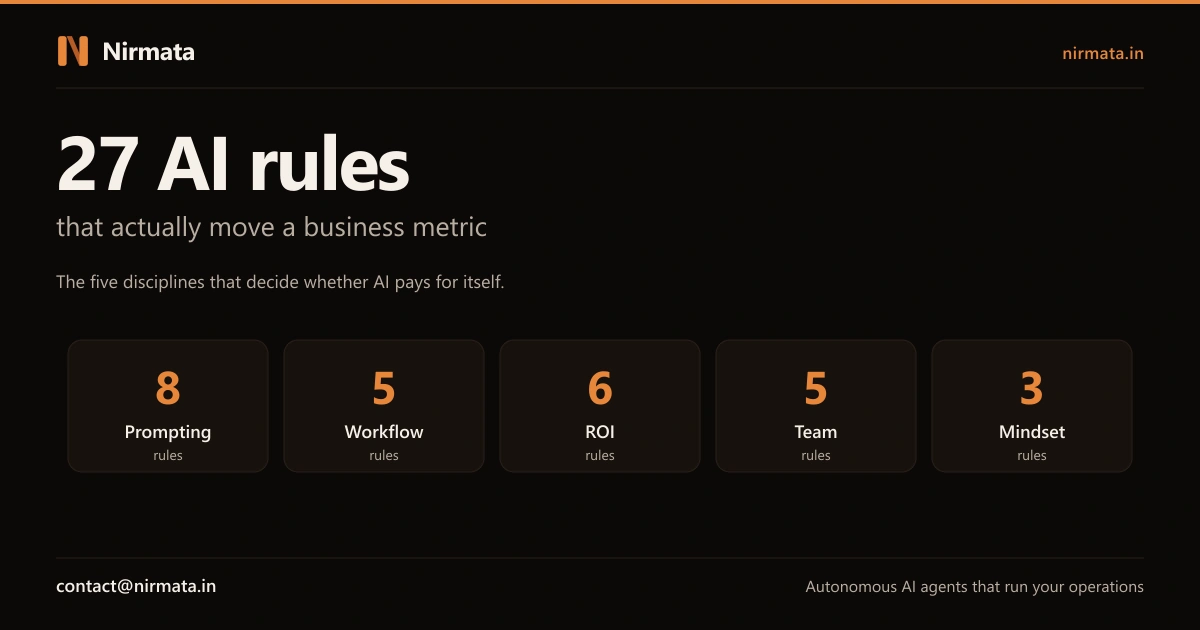
Below are the 27 AI rules for business owners that we apply in our own production deployments, grouped into the five disciplines that decide whether AI pays for itself. None of them requires a bigger budget.
1. Prompting and communication: 8 rules
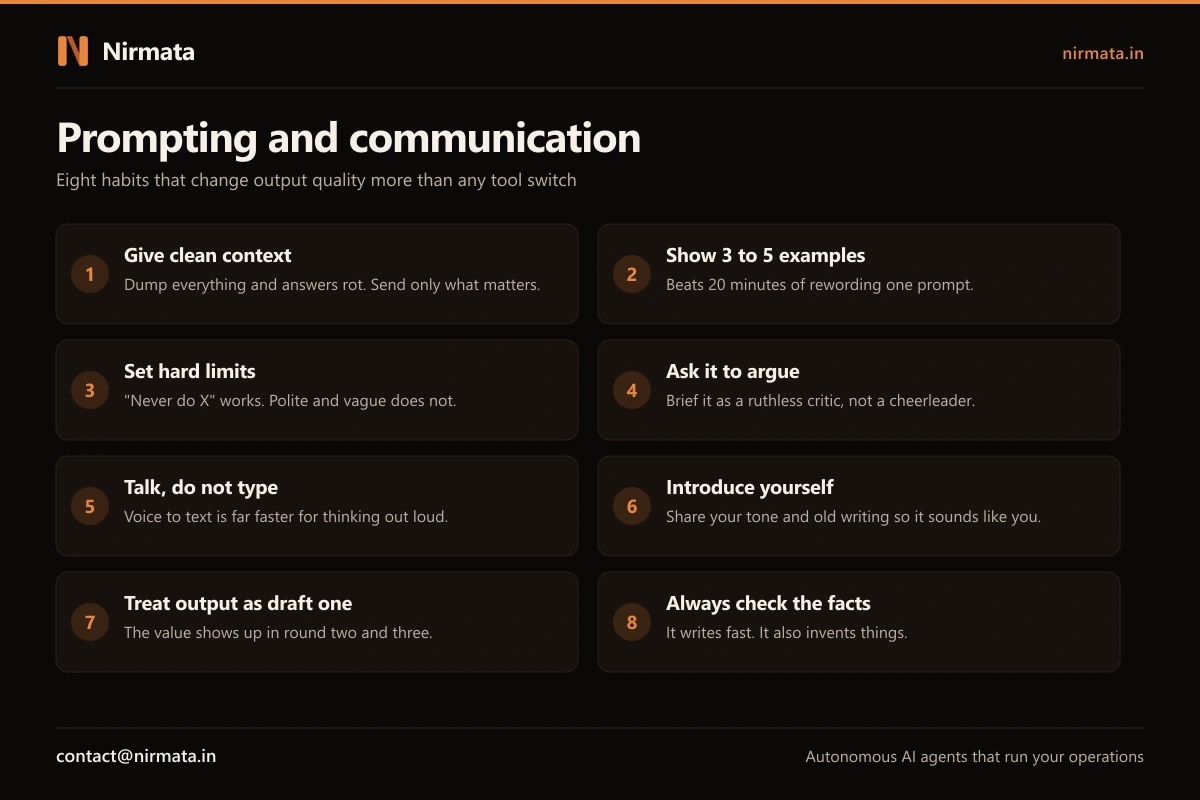
Output quality is mostly an input problem. These eight habits move results further than switching models will. For the evidence behind those habits, see which AI tips and tricks survived controlled testing and which quietly stopped working.
Two of them deserve a sentence more. Clean context is counter-intuitive, because people assume more background is always safer, when in practice irrelevant detail competes with your instruction and the answer drifts. And introducing yourself is not vanity: without a sample of your own writing, a model defaults to the average of everything it has ever read, which is exactly the flat tone people complain about.
- Give clean context. Dumping everything you have makes answers worse, not better. Send only what is relevant.
- Show 3 to 5 examples. This beats twenty minutes of rewording a single instruction.
- Set hard limits. “Never do X” works. Polite and vague does not.
- Ask it to argue. Brief it as a ruthless critic or mentor, not a cheerleader.
- Talk, do not type. Voice to text is far faster for thinking out loud.
- Introduce yourself. Share your tone and a few old pieces of writing so the output sounds like you.
- Treat every output as draft one. The value appears in rounds two and three.
- Always check the facts. It writes fast, and it also invents things.
The last one is where the money is lost. Speed is real, but so is confident invention, and the cost of a wrong answer lands on you, not the model. We have written separately about what AI hallucinations actually cost a business, including cases where a company was held to what its chatbot said.
2. Workflow and process: 5 rules
This is the discipline most often skipped, and skipping it is why pilots stall.
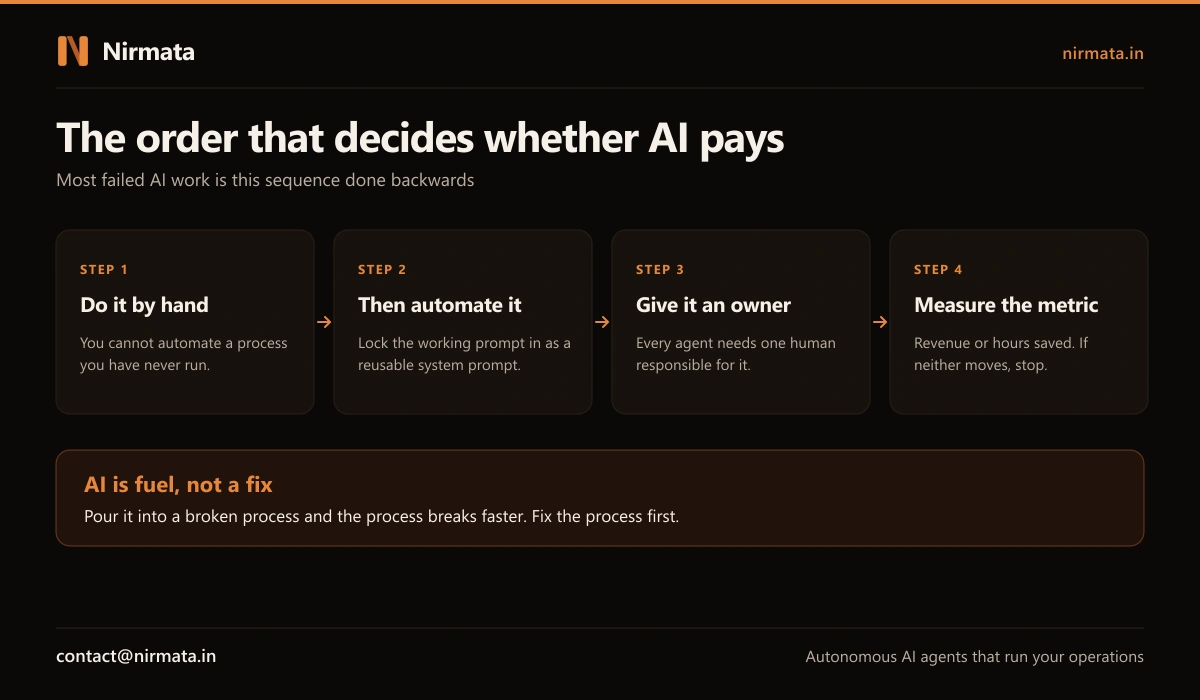
- Do it by hand first. You cannot automate a process you have never run and never defined.
- Have AI check AI. Put a second model in front of the first one’s output before it reaches you.
- Aim at a real problem. Exploring new features without a target outcome is a hobby, not work.
- Lock down what works. When a prompt performs, promote it to a saved system prompt so it is reused, not rebuilt.
- Do not repeat yourself. Keep decisions, rules and context in one place so you stop re-explaining your business every session.
The cheapest quality upgrade there is
Having a second model critique the first one’s work costs a few cents and catches a surprising share of errors before a human ever sees them. It is the single highest-return habit on this list. These habits are visible at scale in the way FIFA deployed AI at the 2026 World Cup.
The last rule quietly saves the most time. Most teams re-explain their own business every session: what the product is, who the customer is, which decisions were already settled. Written down once, somewhere the tools can read it, that context stops being a tax on every single conversation.
3. Business strategy and ROI: 6 rules
Whether AI pays is decided here, and usually before any building starts.
- Sell outcomes, not AI. Customers care about quality and turnaround, not what produced it.
- Measure one metric. If revenue or hours saved is not moving, the project is a distraction.
- Finished beats newest. A working system on last year’s model beats a half-built one on this week’s release.
- Prototype instead of meeting. Build the rough version in minutes rather than discussing it for an hour.
- Name an owner. Every tool and automation needs one human responsible for it.
- Fix the process first. AI is fuel. Pour it into a broken process and the process breaks faster.
Prototyping instead of meeting is the rule that changes calendars fastest. A rough working version answers questions a discussion cannot, and it usually takes less time than the meeting would have.
The order matters more than any individual step. Automating an undefined process just produces failure at higher speed, and an unowned automation rots the first time an input changes. If your pilot worked but the savings never showed up, that gap has a specific cause - we broke it down in why your AI pilot is not saving you money.
From our own deployments
In a direct-to-consumer business turning over GBP 2M, operations consumed 70% of the operating budget, with roughly GBP 140,000 a year going to work that followed fixed rules about 85% of the time. Naming that cost line first is what made the next part measurable: a 68% cut in operational cost within 90 days, net of the system’s own running cost including inference.
4. Team, hiring and leadership: 5 rules
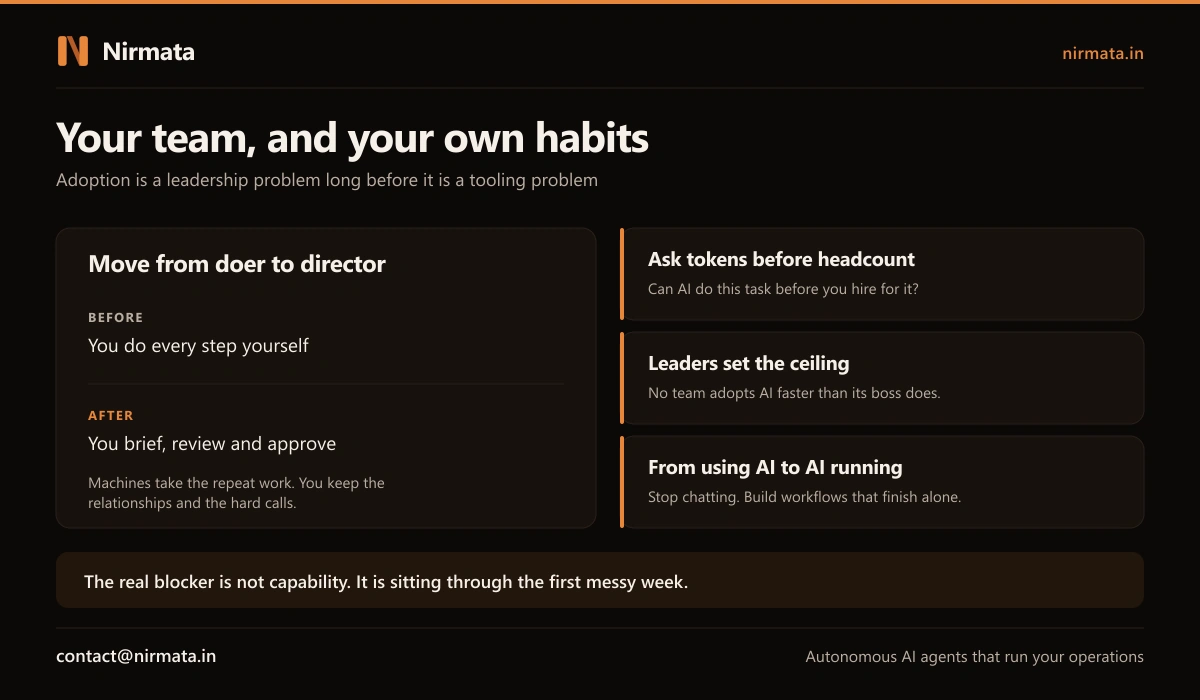
Adoption is a leadership problem long before it is a tooling problem.
- Automate tasks, protect human moments. Give machines the repeat work and keep people on relationships and hard calls.
- Ask about tokens before headcount. Check whether AI can carry a task before you hire for it.
- Move from doer to director. Your job becomes briefing, reviewing and approving, not executing every step.
- Hire people who already use AI. Your AI strategy is mostly a talent strategy.
- Leaders set the ceiling. No team adopts AI faster than the person running it.
That last rule is uncomfortable and consistently true. If leadership treats AI as something the team should look into, the team will treat it the same way. It also cuts the other direction: staff usually adopt AI faster than policy does, which is why your people are probably already using ChatGPT at work whether or not anyone approved it.
5. Mindset and execution: 3 rules
- Use more than one model. Different models are better at different jobs, so route work rather than defaulting.
- Go from using AI to AI running. Stop chatting with it and start building workflows that complete without you.
- Expect a messy first week. The bottleneck is rarely capability. It is willingness to iterate through early friction.
Routing matters more as the work gets specific. One model may be stronger on long documents, another on code, another on cheap high-volume classification. Defaulting to one provider for everything works, but you pay for it somewhere in quality or cost. The same is true of images, where the right generator depends on the job and the license.
The gap between businesses is no longer access to AI. It is who was willing to be bad at it for two weeks.
The second rule is the actual destination, and it is a different thing from having a chat tool open. If you are weighing what that takes, the practical differences between AI skills, agents and an agentic operating layer are the next decision to make.
Myth vs Facts
Myth: “We need the newest model to get results.”
Fact: A finished workflow on an older model beats an unfinished one on the latest release. Model choice is rarely the binding constraint; defined process and ownership are.
Myth: “Better prompts are the skill to invest in.”
Fact: Prompting is eight of these 27 rules. The other nineteen are process, measurement, ownership and adoption, which is where most of the failure actually happens.
Myth: “Customers will object if we use AI.”
Fact: They care about quality, speed and price. What they will object to is sloppy work shipped without review, which is a supervision failure rather than an AI one.
Myth: “AI will fix our messy operations.”
Fact: It accelerates whatever it is given. A broken process automated is a broken process running faster and costing more.
Where AI projects actually die
| What you notice | What it really is | What to do about it |
|---|---|---|
| Output is bland or generic | No examples and no voice given | Add 3 to 5 samples of your own work |
| It worked once, then stopped | The prompt was never saved | Promote it to a system prompt |
| Nobody uses the tool you bought | No named owner | Assign one person, by name |
| Pilot succeeded, costs unchanged | Work moved instead of leaving | Name the cost line before you build |
| Automation keeps breaking | The process was never defined | Run it by hand for a week first |
| Team is not adopting it | Leadership is not either | Go first, publicly |
What this means if you are running a business
You do not need 27 changes. You need the four that unblock the rest, in order.
- Pick one expensive, repetitive task and run it by hand for a week, counting hours
- Write down the single number you expect to move, before building anything
- Give the result one named owner who is responsible when it breaks
- Save the prompt that worked so nobody rebuilds it next month
- Have a second model review the first model’s output before a human does
- Aim at core operations, not marketing copy, if you want the number to move
Which of these are you carrying right now?
Tick each one that is true today.
- We have an AI tool nobody is clearly responsible for
- We automated something we had never documented
- We cannot name the cost line our AI work is meant to reduce
- Our AI use is on marketing and admin rather than core operations
- We rebuild the same prompt from scratch most weeks
- Nobody checks AI output before it reaches a customer
- Leadership has not personally used the tools the team is asked to adopt
If this were your business, here is our first move
We would not recommend a tool. We would spend a week counting: where the operational hours go, and how much of that work follows rules rather than judgment. That count decides everything downstream, including whether AI is the right answer at all.
Then we would pick the single most repeated, most expensive rule-following task, name the number it should move, and build only that. One owner, one metric, one workflow that finishes without a human in the loop.
If you want help doing that count, talk to us. If the honest answer turns out to be that your operations are already lean, we will tell you that instead.