In short: AI search is genuinely removing clicks, but exposure depends almost entirely on your query mix - AI Overviews appear on about 7% of local searches and 95% of comparison searches - and the peer-reviewed evidence says most paid GEO tactics do not work.
Your rankings have not moved. Your traffic has.
That is the version of this we hear most: nothing broke, nobody was penalised, the pages still sit where they always did, and the visitors are simply fewer. Then someone sends you an article saying search is dead, and an agency offers to fix it with something called GEO for a monthly retainer.
Both halves of that are wrong. The click loss is real and measurable, but it is wildly uneven - and most of what is being sold as the fix has now been tested properly and does not work.
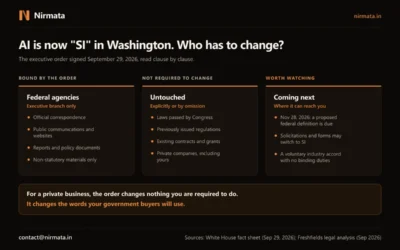
The useful question is not “how do I win at AI search?” It is “how exposed am I, actually?” That is answerable from your own data in an afternoon, and for a lot of small businesses the honest answer is: much less than the headlines suggest. The same goes for policy news: federal agencies renaming AI to super intelligence changes far less for a private business than the coverage implies.
1. The click loss is real. Here is its honest size.
The cleanest evidence is not from anyone selling software. Pew Research Center tracked the actual browsing of 900 US adults who had consented to monitoring, covering 68,879 Google searches in March 2025, of which 12,593 produced an AI summary.
The number to remember
Users clicked a traditional search result in 8% of searches where an AI summary appeared, against 15% where it did not. Only 1% clicked a link inside the summary itself. And browsing sessions ended altogether on 26% of pages with a summary, against 16% without. (Pew Research Center, 22 July 2025. Google disputes the methodology as unrepresentative of its search traffic.)
That 1% figure deserves a moment. It means winning the citation is almost worthless as a traffic strategy. If you are being sold work whose goal is to get your link into the AI answer box, the evidence says the click does not follow.
Ahrefs, across 300,000 keywords, agrees on direction: position-one click-through around 58% lower where an AI Overview appeared (December 2025 data, up from 34.5% a year earlier), and it says plainly that this is correlational, not causal.
Now the part the doom coverage leaves out
Semrush tracked the same keywords before and after they started showing AI Overviews. On those keywords the zero-click rate fell slightly, from 33.75% to 31.53% - people clicked marginally more, not less. Seer Interactive, across 5.47 million queries, found organic click-through on AI Overview queries bottomed at 1.3% in December 2025 and recovered to 2.4% by February 2026.
The aggregate picture is bimodal rather than uniformly grim. Publisher referrals from Google fell around 33% globally in the year to November 2025 across 2,500-plus news sites, while separate analysis found Google organic traffic to the top 40,000 sites fell only about 2.5% in 2025. Something is being hollowed out. It is not everything.
Will AI search actually hurt my business?
It depends almost entirely on what kind of searches bring you customers, and the spread is enormous. AI Overviews appear on roughly 6.9% of local queries, 20% of branded queries and about 5% of transactional ones - against roughly 95% of comparison queries and 86% of question-form queries. By industry, real estate, shopping and arts and entertainment all sat under 3% saturation in November 2025, while science was near 26%.
So a plumber, a dentist, a local retailer, a B2B firm whose buyers search its name - all far less exposed than a site whose traffic came from answering general questions.
The clearest illustration comes from the Daily Mail, which reported click-through 80% to 90% lower when an AI Overview triggered, yet described its overall traffic impact as “very, very low single-digit” percent - because over 60% of its traffic is direct and over 60% of its organic search is branded. The catastrophic per-query number barely touched the business.
The businesses being hollowed out are the ones whose product was the answer. If people search for you, or search to buy, you are in a different category of risk.
That is also why the survivor stories are worth knowing. People Inc lost roughly two-thirds of its Google search traffic over two years, and grew digital revenue 14% and then 8% in the same period, by shifting to direct and owned channels.

2. How much traffic do ChatGPT and Perplexity actually send?
Far less than almost everyone assumes, and this is where owners waste the most money.
Across more than 50,000 websites in 17 industries, Semrush found the median share of traffic from AI systems was 0.14%, against 16.04% from organic search - roughly a hundred-fold difference for a typical site. That is a median across domains, which is the right measure for “what will my business see”; the commonly quoted “about 1%” is a mean across large enterprise domains and overstates it several times over for a small business.
The growth story has also stalled and concentrated. ChatGPT referral traffic plateaued at around a billion monthly visits from November 2025 into early 2026, the number of domains receiving any ChatGPT referral fell from about 260,000 to about 170,000 between October 2025 and February 2026, and over 30% of what it does send goes to just ten domains.
Cloudflare’s crawl-to-referral ratios make the trade visible. For every referral sent in July 2025, the platforms crawled roughly: Google 5 pages, Microsoft 41, Perplexity 195, OpenAI 1,091, Anthropic 38,066. Anthropic’s figure is overstated by an unknown amount because its app sends no referrer header, but the order of magnitude holds. You are being read far more than you are being sent visitors.
Wix confirms it at genuine small-business scale: across roughly 310 million users, platform data published in June 2026 put large language models at under 1% of traffic, against search 42% and direct 40%. Growing fast from a very low base is still a very low base.
The best argument against us
“Volume is not the point - AI visitors convert better.” There is something here: Adobe reported AI-referred traffic converting 54% better than other traffic on US retail sites in May 2026. But the same series showed AI traffic converting roughly half as well in March 2025. A premium that was deeply negative fourteen months earlier is a maturing traffic mix, not an inherent property of the channel - and Adobe published it while launching an AI optimization product. Treat it as promising, not as a reason to reallocate budget from a channel sending a hundred times the volume.
3. The GEO industry has now been tested properly
There is real money here. Adobe bought Semrush for $1.9 billion, closing April 2026 and rebranding it a “brand visibility platform”. Profound raised $96m at a $1bn valuation in February 2026. Several other startups raised eight-figure rounds. Something genuine is being bought.
What is not established is that the optimization works. The strongest evidence is peer-reviewed and negative.
C-SEO Bench, published at NeurIPS 2025, tested ten generative-engine optimization methods across two tasks, six domains, 1,915 queries and four different models. Of 54 method-and-domain combinations, only three reached statistical significance. Traditional SEO outperformed every GEO method tested. And the measured gains converged toward zero as adoption rose - if everyone does it, it stops working. The authors’ conclusion: these methods “are not only largely ineffective but can also have a significant negative impact”.
Three specific tactics are worth naming because they are widely sold:
- llms.txt files. Ahrefs analyzed 137,210 domains: 28% had published a valid llms.txt, and 97% of those files received zero requests in May 2026. No AI bot ever requested one that did not exist. Google’s Gary Illyes has said Google does not support it and is not planning to. Note that OpenAI and Anthropic publishing an llms.txt on their own docs is not the same as consuming yours.
- Keyword stuffing for AI. In the original 2024 GEO paper it scored below doing nothing at all.
- Rewriting body copy to be more quotable. A February 2026 benchmark that kept retrieval and reranking in the loop found body-only optimization reduced top-20 retrieval presence by about 9% and final citation by about 6%. You can optimize yourself out of being found.
The measurement problem nobody selling a dashboard mentions
SparkToro tested this with 600 volunteers running 2,961 prompts: identical prompts returned different brand recommendation lists more than 99% of the time. A separate analysis found 95% confidence intervals on citation share three to six percentage points wide, so a reading of 9.5% might truly be anywhere from 5.5% to 12.5%, and you would need roughly 40 to 50 queries on one engine and 150-plus on another to get a stable number.
Practically: most “we improved your AI visibility by X%” reporting is indistinguishable from noise. One agency chief executive put it plainly to Digiday - use three tools with the same prompts and you get three different answers. Google’s John Mueller was blunter about the acronym wave: “the stronger the push of new acronyms, the more likely they’re just making spam and scamming.”
Which is not a reason to ignore it. It is a reason to buy monitoring, if anything, and not to buy ranking reports.
4. What the evidence does support
Google’s official guidance, updated July 2026, says optimizing for its generative features “is optimizing for the search experience, and thus still SEO”, with a list of things you explicitly do not need: special files, chunking, rewriting for AI, bought mentions, structured-data obsession.
Be appropriately sceptical - Google benefits from saying there is no lever, and its own claims here are thin. Liz Reid’s August 2025 statement that click volume is “relatively stable” and click quality improved contains no figures, no methodology and no baseline whatsoever, and a year later Google had still published none. Watch the units drift too: “billions of clicks daily” became, by mid-2026, billions weekly and only through AI features. The bigger gap is that Google only describes Google - “just do SEO” is well supported for its own surfaces and largely unevidenced for ChatGPT and its peers.
So the defensible list is short and dull:
- Work out your query mix first. Pull the last 12 months from Search Console and split branded, local, transactional and informational. That single split tells you your exposure.
- Stay retrievable: crawlable, text-based content, sound internal linking, accurate business listings. Being well-ranked is close to necessary even if it is not sufficient.
- Being cited does help click-through where an AI Overview appears - about 2.1% against 0.9% when not cited - so it is worth having, just not worth a retainer.
- Shift effort toward channels you own: email, direct, repeat custom, referral. That is what the businesses that survived this actually did.
- Check what AI systems say about you, not just whether they link you. Brand facts get invented, and that is a real cost - see what AI hallucinations really cost a business.
- Buy monitoring, not rank tracking, and only if the spend is trivial next to the channel it is measuring.
On opting out, the accurate answer as of today: for most site owners there is still no way to leave AI Overviews while keeping a normal Google search snippet. The nosnippet directive works but removes your ordinary snippet too. A Search Console control has begun rolling out to a subset of site owners, starting in the UK, after the Competition and Markets Authority imposed a binding requirement on Google on 3 June 2026 - giving it nine months to implement, and also requiring clear link attribution in AI results. The control is site-level, not page-level.
Myth vs Facts
Myth: “69% of searches now end without a click.”
Fact: That figure is for news-related searches, rising from 56% in May 2024 to nearly 69% in May 2025. For the top 100 news and media sites globally the move was 50.5% to 52.7%. The broad US figure most often cited is 68.01% for January to April 2026, from a different panel again.
Myth: “We need to optimize for ChatGPT now.”
Fact: The median website gets 0.14% of its traffic from AI systems against 16.04% from organic search. ChatGPT referrals plateaued from late 2025, and the number of sites receiving any fell by about a third between October 2025 and February 2026. Worth watching; not worth reallocating a budget to.
Myth: “GEO is the new SEO and we are behind.”
Fact: At NeurIPS 2025, only 3 of 54 tested GEO method-and-domain combinations were statistically significant, plain SEO beat all of them, and gains shrank toward zero as more sites adopted them. Separately, 97% of published llms.txt files were never requested at all.
Myth: “A big publisher lost 89% of its traffic, so we could too.”
Fact: That 89% was a worst-case per-query click-through drop, not a traffic figure. The same publisher put its overall traffic impact in the very low single digits, because most of its traffic was direct or branded. Per-query drops and business-level impact are different numbers.
Your exposure, by query type
| How customers find you | AI Overview exposure | What to do |
|---|---|---|
| They search your business name | Low - around 20% of branded queries | Protect the brand record; check what AI says about you |
| Local intent (“near me”, town name) | Very low - around 6.9% | Business listings and reviews, as before |
| Ready to buy or book | Very low - around 5% of transactional | Nothing new needed; protect conversion paths |
| Comparison shopping (“X vs Y”, “best”) | Very high - around 95% | Expect the click to vanish; aim to be the cited option |
| General questions your content answered | High - around 86% of question queries | Highest risk. Move value behind something AI cannot summarize |
| Mostly direct, email and repeat custom | Structurally insulated | Keep investing here; this is what worked for survivors |
What this means if you are running a small business
The businesses hurt worst by AI search are the ones whose traffic was the product: unbranded informational content monetised by volume. If that is you, this is a business-model problem and no amount of prompt-shaped copy will fix it.
If you sell a service, a product or expertise to people who search for you, near you, or to buy - your exposure is genuinely modest, and the correct response is to verify that with your own numbers rather than react to somebody else’s. If you sell products rather than content, the bigger shift is on the buying side, where AI agents now shortlist and purchase on the shopper’s behalf.
Worth saying plainly, because nobody else does: there is no rigorous survey anywhere of small businesses on AI search traffic loss. No statistics agency, no academic body, no membership organization asks it. The only data is three vendor surveys with small or self-selected samples. When you read that some percentage of small businesses are losing traffic to AI, that number came from a marketing exercise.
The most useful figure in that thin evidence is not about traffic at all: in one multi-country survey of just over a thousand owners, around 40% had already found incorrect information about their own business in AI results, and over two-thirds had never checked. Treat the number cautiously - the publisher sells the fix - but checking is free, takes ten minutes, and almost nobody has done it.
What we would not do is buy a new discipline. This is the same pattern we keep seeing across AI generally: the tooling is oversold, the measurement is weaker than the dashboards imply, and the businesses that come out ahead are the ones that measured their own position first. That is exactly the pattern in why small business AI adoption has stalled, and the same test applies here as in deciding whether to build, buy or just use a chat tool: what does this cost, and what number should move?
How exposed is your traffic?
Tick each one that is true of your business.
- Most of our visitors arrive from unbranded, informational searches
- We have not split our search traffic by branded, local, transactional and informational
- Our revenue depends on traffic volume rather than on a customer relationship
- We are paying for a GEO or AI visibility retainer without a defined success metric
- We have never checked what AI assistants say about our business
- We have no meaningful email list or direct channel
- We cannot say what a visit from search is worth to us
If this were your business, here is our first move
We would open Search Console before touching anything else, pull twelve months, and sort queries into four buckets: your name, local, buying, and general questions. The proportion in that last bucket is your actual exposure, and most owners are surprised by it in one direction or the other. Then we would put a value on a search visit - without that, you cannot tell whether losing 30% of clicks is an emergency or a rounding error.
AI search is a real shift and it is removing the click from a large class of queries permanently. But it is not happening to every business at the same rate, and the industry that grew up to fix it has so far failed the tests it has been put to. Measure first. If you want help working out where your traffic comes from and what it is worth, talk to us - and if the answer is that you are barely exposed, we would rather tell you that than sell you a project.