In short: Agentic commerce is already switched on for most US Shopify stores by default, and what decides whether an agent picks you is the accuracy of your product data, not a landing page you can optimize.
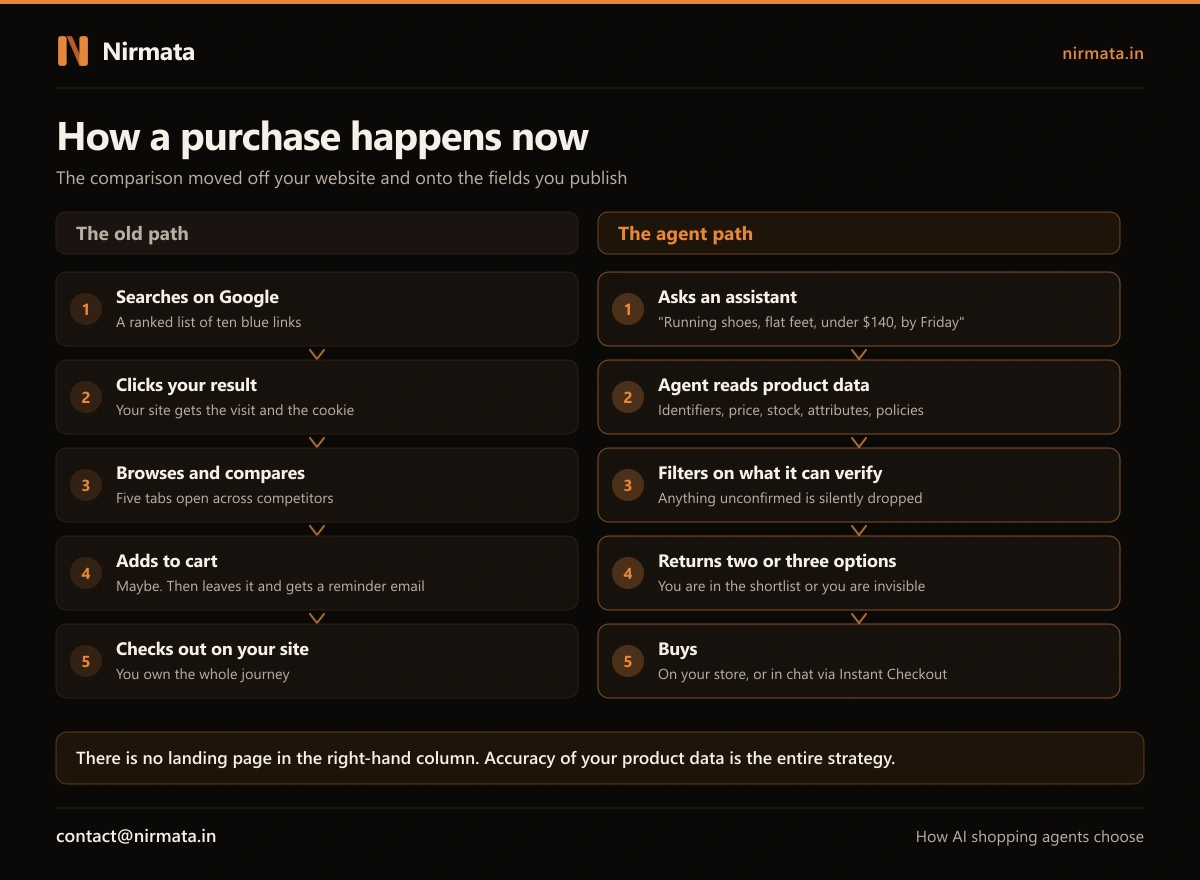
A customer wants running shoes for flat feet, under $140, in stock, delivered by Friday. They do not open five tabs and compare. They ask an assistant, get three options with prices and delivery dates, and buy one.
Your store was either in that shortlist or it was not. Nobody visited your homepage to find out. There was no search result to rank in, no landing page to optimize, and no abandoned cart to email about.
Here is the part most owners have not been told: if you sell on Shopify to customers in the United States, your products are very likely already in that pool. It happened by default, and agentic commerce is the name for what just changed.
What is agentic commerce?
Agentic commerce is when an AI assistant does the shopping. It interprets the request, compares products across merchants using structured product data rather than your web pages, and in some cases completes the purchase. The buyer sees an answer, not a storefront. Your website is no longer the thing being evaluated.
Are my products already visible to AI shopping agents?
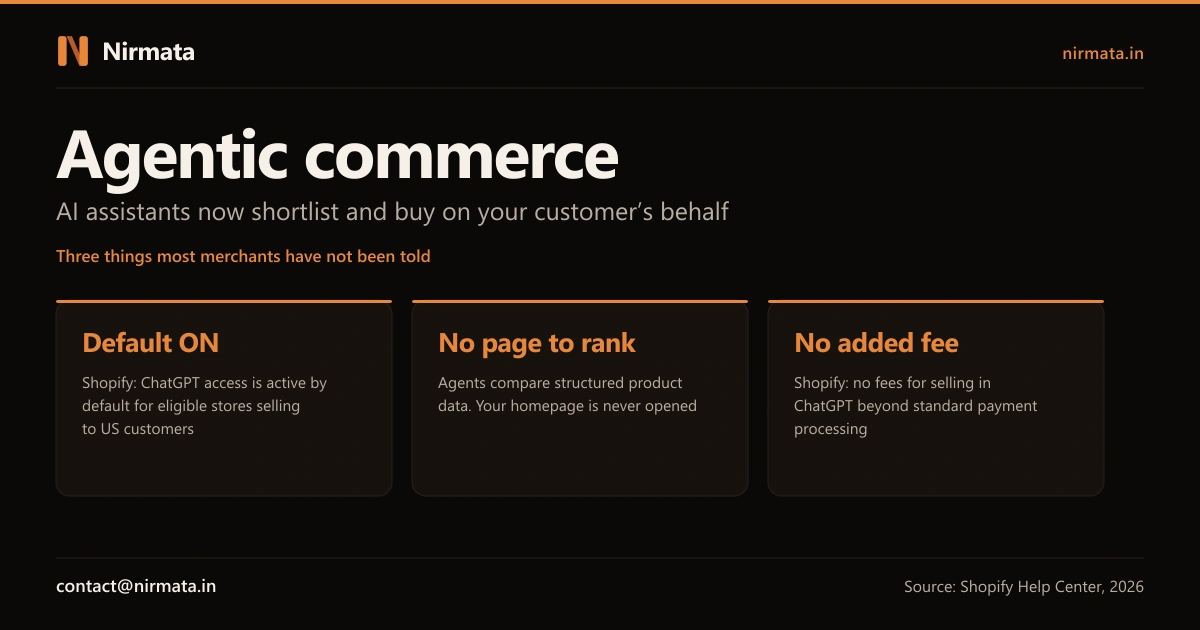
Probably, yes. Shopify’s documentation states plainly that ChatGPT “is active by default for eligible stores,” and that eligibility means your store sells to customers in the United States, your products qualify for Shopify Catalog, you have accepted the Agentic Storefronts supplemental terms, and your store policies are complete.
If you would rather not be listed, that is a deliberate action you have to take: Shopify’s help center describes going to Sales channels, then Agentic, then ChatGPT, and deactivating Shopify Catalog access, which takes up to seven days to process. Most merchants we speak to did not know either the default or the switch existed.
1. The listing is automatic. The ranking is not.
Being eligible puts your catalog in the pool. It does not make an agent choose you. The assistant is filtering on the things it can verify from structured data, and quietly dropping anything it cannot confirm.
What it looks like in production
- A product missing a size or material attribute never appears in the filtered query that would have sold it
- Stock marked available that is not gets you a cancellation and a poor post-purchase signal
- A price that disagrees between your feed and your checkout creates an experience the buyer blames on you
- Two variants that should be one listing show up as duplicates and split whatever ranking signal exists
The fix
Treat the feed as a product, not an export. The accuracy work here is the same operational discipline that decides every other AI project: one source of truth per field, and someone who owns it. We wrote separately about why AI systems fail on business data rather than on models, and this is that problem wearing a commerce hat.
2. Your product feed is the storefront now
For merchants going through OpenAI directly rather than a platform, the requirements are explicit. OpenAI’s commerce documentation requires approved partner status, applied for through a merchant form, and a structured product feed carrying titles, descriptions, images, price and availability, refreshed on a regular cadence. Promotions can only be supplied through the API, not a file upload. Prohibited categories are listed and enforced on the merchant.
Read that list again and notice what is absent. There is no brand story, no design, no copywriting, no page speed. The inputs are your identifiers, attributes, price and stock. That is the whole surface area.
3. Two checkout programs, constantly confused
This is where most of the advice circulating online is simply wrong, and it matters because merchants are making decisions on it.
Selling through Shopify Catalog into ChatGPT is discovery. Shopify’s help center states: “There are no fees associated with selling in ChatGPT. You pay only your standard payment processing fees,” and customers “are redirected to buy products in your online store checkout,” with no in-chat direct checkout to switch on or off.
Instant Checkout is a different program. It runs on the Agentic Commerce Protocol that OpenAI co-developed with Stripe, launched for US shoppers buying from US Etsy sellers, using what Stripe describes as a Shared Payment Token so the assistant can initiate payment without holding card credentials. The merchant still accepts or declines the order, charges the payment method, calculates and remits sales tax, and handles fulfillment and returns. OpenAI states that merchants pay a fee on completed purchases through that program.
Before you repeat a number you read somewhere
A specific commission percentage for ChatGPT purchases is widely quoted in blog posts and news write-ups. We could not find that figure stated in the primary developer or merchant documentation, and the two programs above have different economics: platform discovery with no added fee, and an approved-partner checkout with an unstated fee on completed orders. If you are modeling margin, get the number from your own merchant agreement, not from an article. That includes this one.
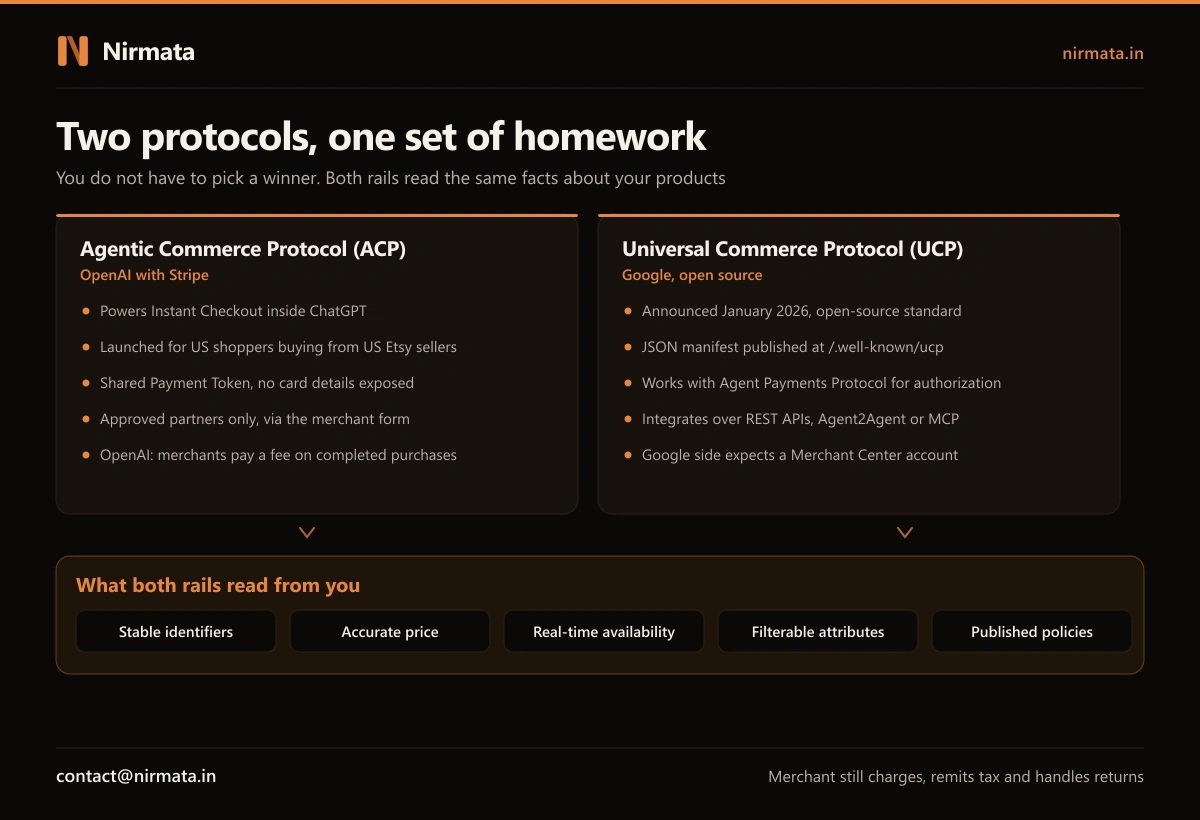
4. Two protocols, one set of homework
There are currently two main rails, and merchants keep asking which one to bet on.
The Agentic Commerce Protocol came from OpenAI and Stripe. The Universal Commerce Protocol is Google’s open-source standard, announced at the start of 2026, in which a business publishes a JSON manifest at a well-known address so agents can discover its capabilities, endpoints and payment configuration without a hard-coded integration. Google’s engineering write-up notes UCP works with the Agent Payments Protocol for payment authorization and can be integrated over plain APIs, Agent2Agent, or the Model Context Protocol, and that Google’s implementation expects an active Merchant Center account with checkout-eligible products. Amazon, Meta, Microsoft, Salesforce and Stripe were reported to have joined its governance council in April 2026, alongside founding members including Shopify, Etsy, Target and Wayfair.
The fix
You do not have to pick a winner, and you should not try. Both rails read the same underlying facts about your products. Clean identifiers, accurate stock, correct pricing and complete policies are the preparation for either one. The protocol integration is a week of engineering. The data is the part that takes a quarter if you have neglected it.
5. What actually breaks after the sale
The failure mode we see is not the technology. It is that an order arrives through a channel nobody has operationally adopted.
What it looks like in production
- Support cannot find the order because it did not come through the usual referral path
- Returns policy stated to the buyer by an agent does not match what your team enforces
- Marketing attribution shows a collapse in one channel and no visible replacement, so budget moves the wrong way
- Nobody has decided who is accountable when an agent states something about your product that is out of date
The fix
Decide, before volume arrives, who owns an agent-sourced order end to end, and make the policy your agent-facing data states the same policy your staff actually enforce. This is the identical discipline behind not letting an assistant invent a return window, which is a mistake that has already cost companies real money.
Myth vs Facts
Myth: “We need to opt in to start selling through AI assistants.”
Fact: For eligible Shopify stores selling to US customers, ChatGPT access is on by default. The deliberate action available to you is opting out, or getting your product data accurate enough that being listed works in your favor.
Myth: “OpenAI takes a fixed cut of every ChatGPT sale.”
Fact: Two separate programs get conflated. Shopify states there are no fees for selling in ChatGPT beyond standard payment processing, with checkout on your own store. Instant Checkout is an approved-partner program where OpenAI says merchants pay a fee on completed purchases. Treat any exact percentage without a primary source as unverified.
Myth: “This is just SEO with a new name.”
Fact: There is no page to rank. The agent reads identifiers, attributes, price and availability, then filters. Copy, design and backlinks do not enter the comparison. It overlaps with how AI search is changing your traffic, but the inputs and the fixes are different.
Myth: “Only large retailers need to think about this.”
Fact: The default listing applies to ordinary stores, not just the retailers named in the press releases. A small merchant with accurate data can be selected over a large one with a stale feed, because the agent cannot see brand size, only fields it can verify.
Agentic commerce readiness: what agents read
| What the agent needs | Where it comes from | What happens if it is wrong |
|---|---|---|
| Accurate price | Product feed or catalog sync | Filtered out, or a price mismatch the buyer blames on you |
| Real-time availability | Inventory system of record | Oversells, cancellations, damaged trust |
| Attributes buyers filter on | Structured product data | Invisible to the specific query that would have converted |
| Clear return and shipping policy | Published store policies | Ineligible, or a promise your team will not honor |
| Stable product identifiers | GTIN and variant structure | Duplicate or merged listings, split signals |
What this means if you’re running AI in your business
The strategic point is smaller and more boring than the coverage suggests. You cannot market your way into an agent’s shortlist. You can only be accurately described in machine-readable terms, or not.
That is good news for operators, because it is finite work with a clear owner, and it is the same foundation every other automation in your business will stand on. Get price and stock to a single source of truth and you have simultaneously prepared for agentic commerce, fixed your reporting, and removed the most common cause of AI systems producing confidently wrong answers about your own catalog.
- Confirm whether your products are already discoverable, then decide deliberately whether to stay in
- One system of record for price and one for stock, syncing to whatever feed you expose
- Every product carries stable identifiers and the attributes buyers actually filter on
- Return, shipping and refund policies published, current, and matching what staff enforce
- A named owner checking feed accuracy on a schedule, not after a complaint
- An agreed process for how an agent-sourced order is supported and returned
Is your store ready for agent buyers?
Tick each that applies to you.
- You do not know whether your products are currently discoverable in AI assistants
- Your stock levels are corrected manually more than once a week
- Price lives in more than one system and they sometimes disagree
- Product attributes are inconsistent across your catalog
- Nobody owns what happens after an order arrives from a new channel
If This Were Your Store, Here’s Our First Move
We would not start with a protocol integration. We would spend the first week finding out what an agent can currently see: whether you are listed, what your feed actually contains, and where price and stock disagree between systems. That audit usually explains more than any strategy deck, and it is work you own permanently regardless of which assistant wins.
Then we would fix the fields that decide inclusion, put a name against feed accuracy, and only afterward look at checkout integration. If you want that audit run properly, tell us what you sell and where and we will tell you what the agents can see today.