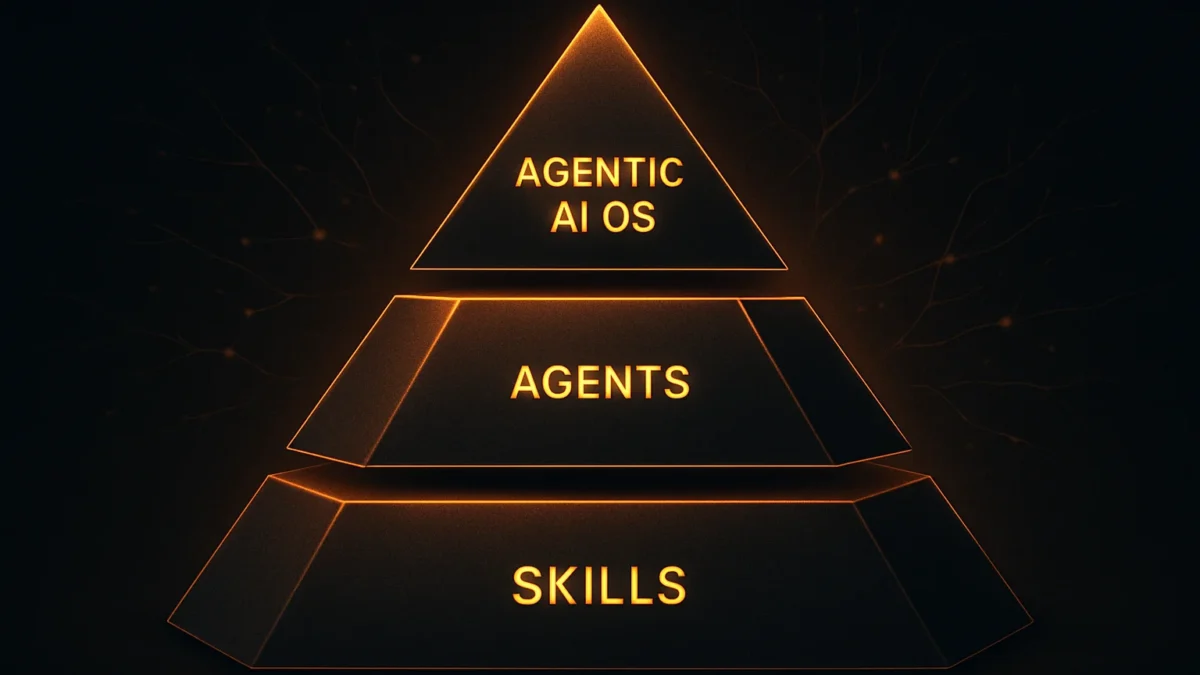
In short: AI comes in three tiers - Skills (one bounded task), Agents (multi-step workflows), and an Agentic AI OS (a whole business function, running continuously). Match the tier to what the task actually requires: overbuild and you pay for complexity you will never use; underbuild and you hit a wall the moment your agents need to coordinate.
The AI industry has a vocabulary problem. Skills, agents, and operating systems get used interchangeably in sales pitches, conference talks, and vendor documentation. But they describe fundamentally different things - and choosing the wrong tier for your business does not just waste budget. It produces AI deployments that fail quietly, look impressive in demos, and deliver nothing at scale.
Agentic AI is not a single category. It is a spectrum. At one end, a single AI skill that classifies customer emails. At the other, a full Agentic AI OS - an autonomous operating layer that runs entire business functions without human oversight. Between them, AI agents that handle discrete multi-step tasks. Understanding exactly what sits at each level is the prerequisite to any useful AI investment decision.
This article gives you the clear-eyed comparison the vendor pitches don’t.
The Three Tiers of AI for Business
Most business AI deployments fit into one of three architectural tiers. Each tier has a distinct definition, a distinct use case profile, and a distinct cost-to-value equation. The tiers are cumulative - a full Agentic AI OS contains agents, and agents use skills - but they are not interchangeable. Calling a skill an “agent” or calling an agent an “AI OS” creates misaligned expectations that are expensive to correct after deployment.
Here is what each tier actually is.
Tier One: AI Skills
An AI skill is a single, bounded capability that performs one specific cognitive task. Sentiment analysis. Named entity extraction. Document classification. Image-to-text. Language translation. A skill takes an input, applies a trained model, and returns a structured output. Nothing more.
Skills are stateless. They do not remember previous inputs, do not make decisions about what to do next, and do not coordinate with other systems unless you build that coordination explicitly outside the skill itself. Each invocation is independent.
This makes skills highly reliable and highly testable. You know exactly what a skill is supposed to do, you can write unit tests for it, and when it fails it fails in predictable ways. They are also the fastest to deploy - days, not months - and the cheapest to operate at scale because they run deterministically on simple inference pipelines.
When skills are the right choice: You have a single, well-defined cognitive task that currently requires human time - classifying incoming tickets, extracting line items from invoices, flagging compliance issues in contracts. The task is bounded, repetitive, and the output feeds a human decision or a downstream system. If the input is structured and the desired output is structured, a skill is almost certainly the right tool.
When skills are not enough: The task requires multiple steps, requires the AI to decide what to do next based on intermediate results, or requires the AI to interact with external systems autonomously. A skill that classifies an email cannot also respond to it, update the CRM, and escalate to a human if the sentiment score drops below a threshold. That requires an agent.
Tier Two: AI Agents
An AI agent is an autonomous system that pursues a defined goal by deciding, at each step, what action to take next. Unlike a skill, an agent has access to tools - APIs, databases, search, email, other skills - and uses a reasoning layer to determine which tool to use and in what order. The agent continues operating until it reaches the goal or hits a defined stopping condition.
This is a meaningful architectural difference. A skill is called; an agent is deployed. You give an agent a goal (“process this support ticket end to end”) and it handles the sequence: read the ticket, check order history, draft a response, send it, update the ticket status, flag for human review if the issue is unusual. Each step is decided in real time, not hardcoded in advance.
AI agents are more powerful than skills and significantly more complex. They can fail in non-obvious ways - the reasoning step can go wrong, tools can return unexpected outputs, and multi-step tasks create multiple failure surfaces. They require more careful prompt engineering, more robust error handling, and more monitoring than skills do.
When agents are the right choice: You have a business workflow that involves multiple steps, multiple systems, and conditional logic - but the workflow is bounded and the success state is clear. Customer service resolution. Invoice processing from receipt to payment. Lead qualification and CRM enrichment. These are multi-step, multi-tool tasks with a defined end state. Agents handle them well.
When agents are not enough: Your business needs do not map to discrete workflows. Operations run continuously. Decisions in one function affect decisions in another. The system needs to prioritize across competing demands, remember context from days or weeks ago, and improve its own performance over time. That is not an agent. That is a full Agentic AI OS.
Tier Three: The Agentic AI OS
An Agentic AI OS is a permanent autonomous operating layer for a business. It is not a single agent or a suite of tools - it is an architecture. At the center is an orchestrator: a reasoning system that understands business context, manages competing priorities, routes work to specialist agents, and makes decisions that span multiple functions simultaneously. Around it, a set of specialist agents, each responsible for a domain - operations, sales support, finance reconciliation, whatever the business needs. Connecting everything, a persistent memory layer that retains context across sessions, days, and months. And wrapped around all of it, feedback loops that allow the system to learn from outcomes and improve its own performance.
The key distinction is permanence. An agent is invoked when there is a task. An Agentic AI OS is always running. It monitors, it acts, it learns, and it continues operating whether anyone has submitted a task or not. It runs business functions the same way a piece of infrastructure does - as a constant, not a service call.
This is what distinguishes Nirmata’s approach from typical AI automation vendors. We are not building workflows. We are building operating layers - systems that take over the management of entire business functions and run them autonomously, indefinitely.
When an Agentic AI OS is the right choice: You are spending significant operational budget on work that is predictable, repetitive, and currently managed by a combination of humans and disconnected tools. You want to remove that cost permanently, not partially. The business functions in question do not need daily human management - they need human oversight and exception handling. You are ready to invest in an infrastructure-grade AI deployment rather than a feature addition.
A skill is called. An agent is deployed. An Agentic AI OS is never switched off.
How to Choose: A Decision Framework
Describe the job in one sentence. If it is take input X, return output Y with no decisions in between, it is a skill. If it needs to decide the next step and touch several systems, it is an agent. If it is run this function continuously and handle whatever comes up, it is an Agentic AI OS.
The decision is not really about preference. It is about what your use case actually requires - and whether you should build it, buy it, or just use a chat tool.
Start with the task definition. If you can describe the task as “take input X, return output Y” with no intermediate decisions or external system interactions, the answer is a skill. If the task requires multiple steps, conditional branching, or tool use, the answer is an agent. If the task is better described as “run this business function continuously and handle anything that comes up,” the answer is an Agentic AI OS.
Then consider operational continuity. Skills and agents are activated by triggers. An Agentic AI OS runs continuously. If your use case requires permanent operation - 24/7 monitoring, proactive action, context retention across weeks - only the third tier will actually deliver it.
Finally, consider your organization’s readiness. Skills require the least from your team. Agents require clean data pipelines and well-defined success states. A full Agentic AI OS requires your business to be able to hand off a business function entirely - which means the function must be understood well enough to define its rules, exceptions, and escalation logic. Businesses that cannot articulate how a process currently works should start with skills and agents to develop that understanding before building an OS.
The Two Mistakes Most Businesses Make
Overbuild and you pay for orchestration, memory, and maintenance a single skill would have handled for a fraction of the cost. Underbuild and you ship agents that work in isolation but collide the moment they have to share context - and retrofitting an orchestrator after the fact is far more expensive than planning for one up front.
The first mistake is overbuilding for the use case. A business with a straightforward document classification problem does not need an Agentic AI OS. Deploying one creates unnecessary complexity, cost, and maintenance burden. The right tool for a tier-one problem is a tier-one solution. Vendors who sell tier-three solutions to every problem are selling you complexity you will not benefit from.
The second mistake is underbuilding for scale. A business that starts with agents - correctly, for the right use cases - often fails to plan for the point where multiple agents need to coordinate, share context, and make decisions that affect each other. That is when the absence of an orchestration layer becomes expensive. Agents without an orchestrator become hard to manage, inconsistent in their outputs, and increasingly unreliable as complexity grows. The businesses that scale agentic AI successfully plan the orchestration layer before they need it.
The path that works: start with a well-defined skills or agents deployment, prove value, and build toward the OS tier with a clear architectural plan for how the pieces will connect. Do not start with a full operating system on day one unless you are genuinely ready to hand off a business function entirely.
Which tier does your use case actually need?
Tick every signal that sounds like your situation, then see where you land.
- The task has multiple steps that depend on each other
- It has to decide what to do next based on intermediate results
- It must touch several systems (CRM, email, database) in one run
- It needs to run continuously, not only when triggered
- It needs to remember context from days or weeks ago
- Several automations already need to coordinate and share context
Quick Reference Table
| Property | AI Skill | AI Agent | Agentic AI OS |
|---|---|---|---|
| Scope | Single task | Multi-step workflow | Full business function |
| State | Stateless | Session context | Persistent memory |
| Operation | On demand | On demand | Continuous |
| Coordination | None | Tools only | Multi-agent orchestration |
| Learning | No | No | Yes - feedback loops |
| Time to deploy | Days | Weeks | Months |
| When to use | Defined input/output task | Multi-step workflow | Replace a business function |
For a deeper understanding of AI agent architecture, see the Wikipedia overview of intelligent agents as a technical reference point. The principles there map directly to how production AI agents are designed.
Once you’ve determined which tier fits your use case, go deeper: the Agentic AI OS explained in full covers exactly how the autonomous operating layer is structured and deployed. And if you want to see what the ROI looks like in practice, this case study covers a 68% operational cost reduction achieved with agentic AI over 90 days.