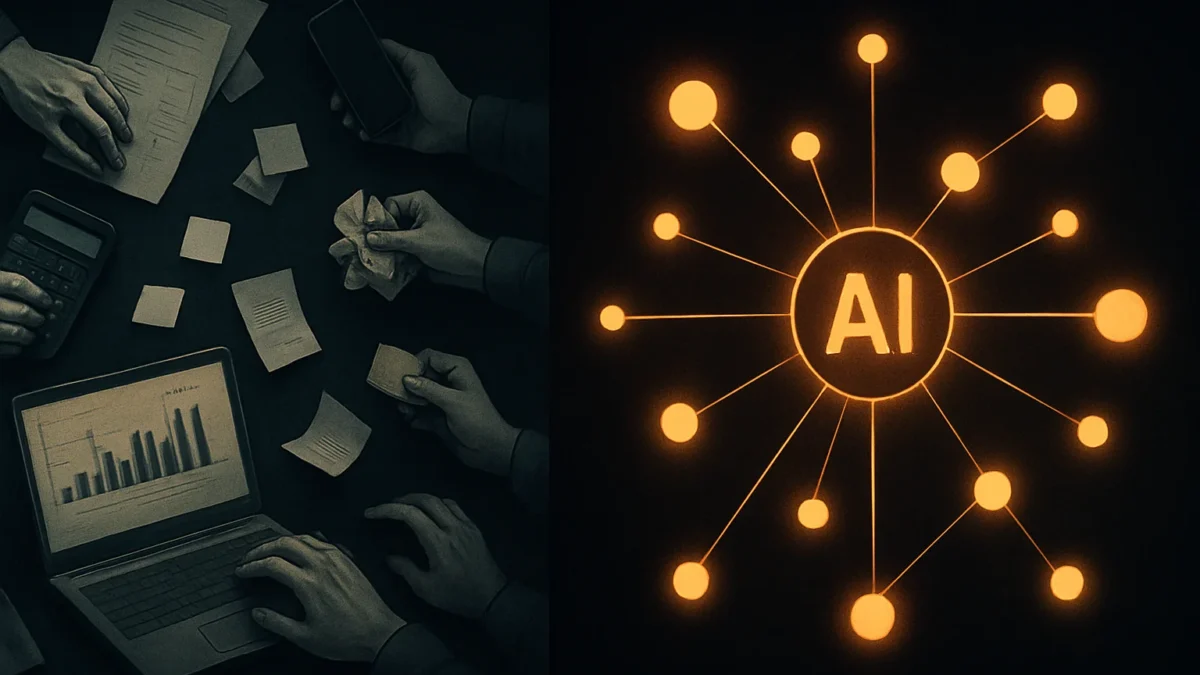
In short: A £2M D2C brand was spending 70% of its operational budget on predictable, rule-based work. Over 90 days we deployed a three-agent Agentic AI OS across support, finance, and operations - cutting operational costs 68%, dropping support resolution from 11 minutes to under 90 seconds, and paying back the entire build in under five months.
A D2C brand operating at roughly £2M annual revenue was spending 70% of its operational budget on tasks that followed completely predictable patterns. Support tickets that followed the same resolution paths. Order queries that required the same CRM lookup and the same templated response. Supplier invoices that moved through the same four-step approval process every time. The work was not complex. It was just constant - and constant work that follows predictable patterns is exactly what agentic AI is designed to handle.
Over 90 days, we built and deployed an agentic AI operating system for their core operations. By day 90, operational costs were down 68%. This is how it happened - the architecture, the rollout, and the numbers.
The Starting Point: Where the 70% Was Going
Before starting any agentic AI build, we run a cost attribution analysis - a detailed breakdown of where operational budget is actually going and why. In this case, three functions consumed the bulk of the spend:
Customer support: A team handling roughly 300 tickets per week. The majority were order status queries, return requests following a standard policy, and shipping delay notifications. Resolution was largely templated but required a human to look up the order, apply the policy, draft the response, and update the CRM. Each ticket took between 8 and 15 minutes. Almost none required genuine judgment.
Finance operations: Monthly reconciliation, weekly invoice processing, and daily accounts payable. The reconciliation process alone took two days of a bookkeeper’s time every month. The invoice approval workflow required four sign-offs that followed identical criteria every time.
Operations coordination: Supplier communication, inventory alerts, and fulfilment exception handling. Largely reactive - the operations coordinator spent most of their time responding to the same categories of exception with the same responses.
Taken together, these three functions represented approximately £140,000 per year in staff time performing work that, once mapped, turned out to be roughly 85% rule-following and 15% genuine judgment. That ratio is the signal that agentic AI deployment will produce significant returns.
Why Agentic AI, Not RPA or Chatbots
“Our support is too messy to automate - every ticket is a little different.” That is precisely the point. Messy variability is where RPA scripts break and chatbots give up. Agentic AI is the only tier that reasons through the variation instead of failing on it - which is why it captures the expensive 15%, not just the easy FAQs.
The first question most businesses ask at this stage is: why not use RPA? Or why not just install a chatbot?
Robotic Process Automation would have worked for portions of the invoice processing workflow - structured inputs, defined outputs, stable interfaces. But the support function requires handling natural language, variable inputs, and policy interpretation. RPA breaks the moment anything deviates from the script. In a support context, everything deviates occasionally.
A chatbot would have captured the easiest tier of support queries - FAQs, order status lookups - but would have handled nothing else. The more interesting, higher-cost part of the support workload (return policy disputes, fulfilment exceptions, escalations) requires multi-step reasoning and CRM access. A chatbot cannot do that.
Agentic AI handles both. A support agent can receive a natural language request, look up the order, apply policy logic, draft a contextually appropriate response, send it, and update the CRM - all in a single automated workflow. And when the situation genuinely requires human judgment, it escalates cleanly rather than failing.
The distinction between automation tools and agentic AI is not about complexity of setup. It is about the ability to reason under variability. That capability is what makes the 68% cost reduction achievable - not just the easy, scripted parts, but the messy real-world variation that breaks traditional automation.
What We Built: The Three-Agent System
The deployment consisted of three specialist agents coordinated by a central orchestrator, built on Nirmata’s Agentic AI OS architecture.
The Support Agent handled the full customer-facing support workflow. It received incoming tickets via the support platform API, classified them by type and urgency, retrieved the relevant order data from the CRM, applied the appropriate policy rule, drafted a response, and sent it. For anything it classified as requiring human review - complaints about damaged goods, escalation requests, anything above a defined complexity score - it created a flagged task in the human queue rather than attempting autonomous resolution.
The Finance Agent handled invoice receipt, data extraction, three-way matching against purchase orders and delivery confirmations, and routing for approval. For invoices that matched without discrepancy, it processed them automatically. Discrepancies were flagged with a structured summary for human review. It also ran the weekly reconciliation, comparing bank transactions against accounting records and generating a discrepancy report rather than requiring someone to do the manual comparison.
The Operations Agent monitored inventory levels against defined reorder thresholds, generated supplier communication drafts when stock fell below threshold, tracked outstanding deliveries, and sent daily operations summaries to the management team. It did not make purchasing decisions - those remained human - but it eliminated the monitoring and communication overhead that had consumed most of the operations coordinator’s week.
All three agents shared access to a central memory layer that stored context across sessions: customer history, supplier relationships, previous escalation decisions, and the evolving rule set that governed each agent’s behavior. This shared memory is what prevents the system from making the same classification error twice.
The 90-Day Rollout
The first two weeks ran every agent in shadow mode - decisions logged, never acted on - and surfaced 23 edge cases that would have produced wrong answers in production. None were visible in the policy documentation. You do not discover edge cases by reading; you discover them by watching real decisions against real data.
Days 1-14: Integration and shadow mode. We connected the agents to the live systems - support platform, CRM, accounting software, inventory system - but ran them in shadow mode. Every decision the agents made was logged but not acted on. The outputs were compared against what the human team actually did. Discrepancy analysis identified gaps in policy logic and edge cases the initial training had not anticipated.
Days 15-30: Supervised deployment. The Finance Agent went live for invoice processing. The Support Agent went live for order status queries only - the lowest-risk, highest-volume ticket type. Human review of every agent action continued, but the agents were now making real decisions. The error rate at this stage was approximately 4% - one in 25 decisions needed human correction. Each correction was fed back into the agent’s context.
Days 31-60: Scope expansion. The support agent’s scope expanded to cover returns processing and shipping delay notifications. The operations agent went live. Error rate for the support agent had dropped to under 1.5% - partly from the feedback loop, partly from refinements to the policy prompts identified during the supervised phase. The Finance Agent was processing over 90% of invoices without human touch.
Days 61-90: Full operation and measurement. All three agents operating at full scope. Human team shifted from doing the work to reviewing exception reports. Time previously spent on routine operations was redirected to higher-value activities. The 90-day cost attribution analysis was run again.
The Numbers: 68% Cost Reduction Explained
68% operational cost reduction across the three automated functions · 73% fewer staff hours on that work · support resolution 11 min → under 90 sec · invoice error rate under 1.5% by day 60 · full build paid back in under 5 months. Figures are net of the system operating cost - inference, memory, and our monitoring.
The 68% figure covers the operational functions that were automated - customer support, finance operations, and operations coordination. It is not a site-wide cost reduction claim.
Staff time in those three functions dropped by approximately 73% measured in hours. Not all of that translated directly to headcount reduction - some of the freed capacity was redirected to other work. The cost reduction figure accounts for actual cost savings (reduced hours on operational tasks) net of the system’s operating costs (inference, memory storage, API calls, and our ongoing monitoring and maintenance).
The cost of the agentic AI deployment itself - build, integration, and 90 days of operation - paid back in under five months at the measured run rate. After that point, the system’s cost is operational infrastructure spend, not a project investment.
Speed also improved. Average support ticket resolution time dropped from 11 minutes (human) to under 90 seconds (agent). Invoice processing that previously took two working days per month now runs continuously, with the reconciliation report available at any time rather than once a month.
We removed the 85% of work that was routine so the team could finally give full attention to the 15% that actually needed a human.
What the Business Learned
Three things stood out from the post-deployment review.
The 15% that still required humans was the most valuable 15%. The cases the agents escalated - genuine disputes, unusual situations, relationship-sensitive conversations - were exactly the cases where human judgment produced disproportionate value. By removing the 85% routine work, the human team could give better attention to the 15% that actually needed them.
Shadow mode is not optional. The two-week shadow phase surfaced 23 edge cases that would have produced incorrect automated responses in production. None of them were obvious from the initial policy documentation. You do not discover edge cases from documentation; you discover them from observing real decisions against real data.
The memory layer is where the compounding happens. At day 30, the system was good. At day 90, it was better - not because of deliberate retraining, but because 60 days of feedback had accumulated in the memory layer. The system that ran on day 90 was measurably more accurate than the system that ran on day 15, without any manual intervention between those points.
Is your operation a candidate for agentic AI?
Tick every signal that describes your day-to-day operations.
- A team repeats the same lookups and templated responses all day
- Approvals follow identical criteria every single time
- Reconciliation or reporting eats fixed hours every week or month
- Most of the work is rule-following; only a slice needs real judgment
- The inputs are digital and the success criteria are measurable
What This Model Looks Like in Other Businesses
The specific functions automated here - support, finance, operations - are common across many business types, but they are not the only functions that follow the “mostly predictable, occasionally complex” pattern that makes agentic AI deployments viable.
In professional services, the pattern appears in proposal generation, client reporting, and billing. In e-commerce, in inventory management, supplier coordination, and post-purchase communication. In SaaS, in customer onboarding, renewal management, and usage monitoring. The specific agents differ; the architectural pattern - orchestrator, specialists, shared memory, feedback loops - is consistent.
The relevant question for any business is not “can agentic AI help us?” Almost certainly it can. The relevant question is: which functions are primarily composed of predictable, rule-based work? Map those, measure the cost of the human time currently spent on them, and you have the business case. The 68% is not a target - it is an outcome of applying the right architecture to the right problem. The target is specific to your cost structure and your functions.
For the underlying architecture behind this deployment, read what an Agentic AI OS actually is and how it is structured. If you are earlier in your evaluation, the comparison between AI skills, agents, and a full AI OS will help you determine where to start.