In short: An Agentic AI OS is not a chatbot, a workflow tool, or a suite of AI apps - it is a permanent autonomous layer that runs entire business functions without daily supervision. It has four parts: an orchestrator, specialist agents, persistent memory, and self-learning feedback loops. Miss any one and it is not yet an OS.
An Agentic AI OS is not a chatbot. It is not an automation workflow. It is not a dashboard or a suite of AI tools you log into each morning. It is a permanent autonomous operating layer - software that takes over the management of entire business functions and runs them continuously, without daily human supervision.
The term sounds abstract. The reality is concrete: sales pipeline management that never stops, support triage that operates at 3am as effectively as 3pm, financial reconciliation that runs in the background every hour rather than once a week. The business function continues operating whether or not anyone on your team is paying attention to it. That is the definition of an Agentic AI OS - and it is a meaningfully different thing from anything that came before it.
What an Agentic AI OS Is Not
Buy a chatbot when you needed an operating layer and you automate the easy 20% while the expensive work stays manual. Buy RPA and it breaks the first time an interface or an edge case shifts. The mislabel is not a semantic problem - it is a budget spent on a system that cannot do the job you actually have.
The clearest way to define a new category is often to define what it excludes. An Agentic AI OS is not any of the following, even though all of them are marketed using similar language.
Not a chatbot. A chatbot responds to questions. An Agentic AI OS acts on goals. A chatbot waits to be asked. An Agentic AI OS monitors, decides, and acts without being prompted. When a chatbot finishes a conversation, it stops. An Agentic AI OS does not stop.
Not a workflow automation tool. Zapier, Make, and similar tools execute predefined sequences when triggered. They are fast and useful for automating repeated handoffs. But they cannot reason - they can only follow the script you wrote for them. When something unexpected happens, they fail or wait for a human to intervene. An Agentic AI OS reasons about unexpected situations and decides how to handle them.
Not a suite of AI tools. AI tools assist humans. An Agentic AI OS replaces the human management layer for specific functions. The distinction matters: a tool that helps someone do their job faster still requires someone to do the job. An Agentic AI OS does the job.
Not RPA. Robotic Process Automation executes rigid, brittle scripts on interfaces. It breaks when interfaces change and requires constant maintenance. An Agentic AI OS uses AI reasoning to navigate variability - it adapts when things change rather than breaking.
The Working Definition
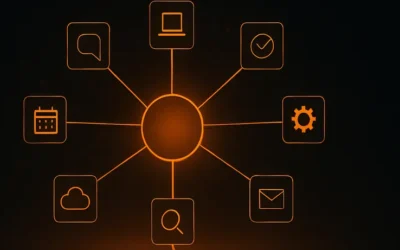
An Agentic AI OS is a multi-agent system with four integrated layers: an orchestrator that manages competing priorities and routes work, specialist agents that execute in specific domains, a persistent memory layer that retains context across time, and feedback loops that allow the system to improve from experience. Together, these layers create something that behaves less like software and more like a competent member of staff who never sleeps, never forgets, and never gets bored.
The operative word is “autonomous.” The system does not need instructions for each task. It has been given goals - reduce resolution time, maintain cash flow, keep pipeline velocity above a threshold - and it pursues those goals using whatever actions are available to it. It escalates to humans only when it encounters situations outside its defined operating envelope.
The Four Core Components of an Agentic AI OS
Orchestrator, specialist agents, persistent memory, feedback loops. If a vendor demo is missing any one of the four, you are looking at a partial system - more capable than a single agent, but not an operating layer that will run a function unattended and get better over time.
Every functional Agentic AI OS has these four components. Deployments that are missing one or more of them are partial systems - more powerful than single agents, but not yet an OS in the meaningful sense.
1. The Orchestrator
The orchestrator is the reasoning center. It understands the business context - current goals, active constraints, the state of ongoing tasks - and makes decisions about what needs to happen next. When a new input arrives (a new support ticket, a new lead, a new invoice), the orchestrator decides which specialist agent should handle it, in what priority order, and with what contextual information passed along. The orchestrator also resolves conflicts - when two agents have competing resource demands, or when a goal from one function contradicts a goal from another.
Without an orchestrator, you have a collection of agents. With an orchestrator, you have a system.
2. Specialist Agents
Specialist agents are responsible for specific domains. A customer success agent. A finance reconciliation agent. An outbound communications agent. A data quality agent. Each is optimized for its domain - given the tools, the prompts, and the operational rules specific to its function. Specialists are narrow by design: depth of performance in their domain is more valuable than breadth.
The number of specialists scales with the complexity of the business functions being automated. A simple deployment might have three. A full business operating system might have fifteen.
3. Persistent Memory
Persistent memory is what separates a stateful system from a stateless one. Every interaction the Agentic AI OS has - with customers, with internal data, with outcomes - is stored in a structured memory layer. The system can recall what it decided last week, why it escalated a particular issue, what a customer said in a support ticket three months ago. This is what allows the OS to build genuine context over time rather than starting fresh with every invocation.
Without persistent memory, an AI system cannot learn from experience. It repeats the same decisions regardless of what happened last time. Persistent memory is not optional - it is the foundation of improvement.
4. Self-Learning Feedback Loops
A feedback loop connects outcomes back to the system’s decision-making. When an agent’s action produced a good result, that information strengthens the underlying decision process. When an action produced a bad outcome - a customer escalated, a payment failed, a lead was incorrectly qualified - that information is used to adjust future decisions. The system gets better the longer it runs, without requiring manual retraining or intervention.
This is the component most often missing from “AI automation” deployments. Without feedback loops, a system that makes mistakes continues making the same mistakes. With them, the mistake rate decreases over time as the system updates its internal model of what good decisions look like.
An agent is invoked when there is a task. An Agentic AI OS is always running - it monitors, decides, and acts whether or not anyone has asked it to.
How an Agentic AI OS Differs from Traditional Automation
Traditional automation is brittle, deterministic, and reactive. It executes a predefined script when triggered. It cannot handle edge cases. It breaks when the input deviates from what the script expected. And it does not improve - the automation you deploy in January is the same automation running in December, regardless of how much your business has learned in that time.
An Agentic AI OS is robust, probabilistic, and proactive. It handles edge cases through reasoning, not scripted fallbacks. It monitors for conditions that require action rather than waiting to be triggered. And it improves - each decision is an opportunity to update the system’s understanding of what good performance looks like.
The practical consequence is a fundamentally different maintenance profile. Traditional automation requires constant human attention to keep scripts aligned with reality. An Agentic AI OS requires oversight and exception handling, but not constant maintenance. It adjusts to change; it does not need to be re-scripted every time something changes.
For a technical reference on how multi-agent systems are structured, the Wikipedia entry on multi-agent systems provides a useful technical foundation that maps closely to production Agentic AI OS architecture.
What Business Functions an Agentic AI OS Can Run
The honest answer: any business function that is primarily composed of information processing, decision-making under known rules, and communication. The functions that typically reach full autonomous operation fastest are those where the inputs are digital, the success criteria are measurable, and the exception rate is low.
Customer support triage and resolution - classifying, routing, drafting responses, escalating, updating CRM, and closing tickets, end to end.
Sales pipeline management - lead scoring, qualification, outreach sequencing, follow-up scheduling, and CRM hygiene.
Finance operations - invoice processing, reconciliation, payment scheduling, anomaly detection, and reporting.
Operations monitoring - SLA tracking, vendor performance, inventory signals, alerts, and escalation.
Content and communications - drafting reports, summaries, proposals, and routine correspondence against defined templates and brand rules.
Functions that still require meaningful human judgment - strategic decisions, legal interpretation, novel relationship management - are not good candidates for full autonomous operation. An Agentic AI OS is designed to handle the operational layer so that humans can focus on the judgment layer.
The Implementation Path
Building an Agentic AI OS is a phased process. Businesses that try to deploy a full operating system in a single project almost always fail - the scope is too large, the requirements too poorly understood at the start. The approach that works is incremental.
Phase 1: Foundation. Define the business functions to be automated. Map the inputs, the decision rules, the tools the system will need access to, and the success criteria. Build the memory layer. Deploy two or three specialist agents for the highest-value, most clearly defined functions. This phase produces the first working version of the Agentic AI OS - limited in scope but fully functional.
Phase 2: Orchestration. Add the orchestrator. Connect the specialists so they can share context and coordinate. Add more specialist agents as new functions are onboarded. The system begins to feel like a coordinated operation rather than a collection of tools.
Phase 3: Feedback loops and scale. Add structured feedback collection. Connect outcomes to decision processes. Monitor the system’s learning rate. Scale volume as confidence grows. This is the phase where the Agentic AI OS begins to demonstrate its compounding value - performance improving as the system accumulates experience.
When Your Business Is Ready for an Agentic AI OS
Is your business ready for an Agentic AI OS?
Tick each statement that is already true for you.
- We spend significant budget on predictable, rule-based operational work
- That work is mostly information processing and known-rule decisions
- We can define what a good outcome looks like and measure it
- Leadership is willing to hand a function to an autonomous system, not just add an AI tool
- The function has exceptions and escalation rules we can write down
You are ready when three things are true. First, you have identified business functions where the cost of human management is high and the nature of the work is primarily information processing and rule-based decision-making. Second, you can define success clearly enough to build feedback loops - you know what a good outcome looks like and how to measure it. Third, you have executive commitment to handing over a business function to an autonomous system, not just adding an AI-assisted tool to an existing workflow.
If any of those three are missing, the right move is to start with AI skills or agents to develop the clarity needed for a full OS deployment. The businesses that deploy Agentic AI OS successfully are the ones that understand their operations well enough to define them - not the ones that hope AI will figure it out.
Want to see what this looks like in practice? This case study walks through a complete Agentic AI OS deployment and the 68% operational cost reduction it produced over 90 days.