In short: Nearly half of agentic AI projects will be canceled by 2027 - on execution, not the models. Here’s the pattern behind the failures, and the 3-question test that decides which side of the 40% you land on.
A boardroom, mid-2027. A slide goes up showing the agentic AI initiative that launched with so much confidence eighteen months ago. Adoption is thin. The numbers haven’t moved. Someone finally asks the question everyone was avoiding: what did we actually get for this? The project is quietly shelved.
According to Gartner, that scene will play out in more than 40% of agentic AI projects by the end of 2027. Not a few unlucky ones - nearly half.
Here’s the part that should change how you plan: those projects won’t fail because the models weren’t smart enough. They’ll fail for reasons that have almost nothing to do with AI - and everything to do with how the systems around the AI were built.
1. The Number Nobody Wants to Hear
The headline figure is Gartner’s: over 40% of agentic AI projects canceled by the end of 2027. Set it next to the wider enterprise-AI picture and a pattern emerges:
- More than 80% of enterprise AI projects fail to deliver their promised business value - roughly twice the failure rate of non-AI IT projects.
- Adoption is near-universal (around 88% of organizations), yet only about 6% are high performers capturing real value.
- Only 29% of organizations report significant ROI from generative AI, and just 23% from AI agents.
This is not an argument against agentic AI. Gartner also expects 40% of enterprise applications to embed AI agents by the end of 2026, up from under 5% in 2025, with the agentic market growing from roughly $7.8B to a projected $52B by 2030. The technology is arriving. The failure rate is about execution, not potential.
The gap between adoption and value is the whole story. Almost everyone is deploying; almost no one is deploying well. The 6% capturing outsized returns aren’t running different models from everyone else - they’re running the same foundation models through very different systems.

2. Why Agentic AI Projects Actually Fail
When a project is canceled, the post-mortem rarely says the model wasn’t capable. The recurring causes are operational:
- No measurable goal. The mandate was ‘adopt AI’, not ‘cut invoice-processing time by 40%’. With no metric, there’s nothing to prove - so it reads as failure even when value exists.
- Weak integration and data access. The hardest part of agentic workflows isn’t intelligence, it’s secure, reliable access to production systems. An agent that can’t safely reach your CRM, billing, or inventory is a demo, not a deployment.
- No governance. No audit trail, no human approval gates, no way to explain a decision. The first time the agent does something wrong in production, trust collapses and the project stalls.
- Everything at once. Teams try to automate a whole department on day one instead of proving one workflow and expanding from there.
Cost of getting it wrong
An agent with unaudited write-access to production isn’t an automation - it’s an incident waiting for a post-mortem. The first wrong action a customer sees costs more trust than the project will recover in a quarter. That is how the rogue agent incidents of 2026 played out: a legitimate goal, real access, and a method nobody approved.
Notice what’s absent from that list: model quality. Swapping providers fixes none of it. And a project can clear every one of these bars, reach production, and still leave the P&L untouched - a separate failure we unpack here.
The obvious objection
“Just wait for a better model - the next release will fix this.” It won’t. Every failure above persists no matter how capable the model gets, because none of them are reasoning failures. A smarter model with no secure data access, no goal, and no governance fails in exactly the same way - just more fluently.
We covered the model-level failure modes separately - hallucination, context loss, and instruction conflict - but those are engineering problems with known fixes. The 40% cancellation rate is a systems and operations problem.
3. What the Surviving 60% Do Differently
The organizations getting real returns share a recognizable architecture - not a better model, a better system around it:
- They start narrow and measurable. One workflow, one owner, one number to move. Value shows up in weeks, and that funds the next step.
- They let code do the computing and the LLM do the reasoning. The teams reporting real ROI architect their systems so the model reasons over what structured code has already computed - not the other way around.
- They treat production access as a first-class problem. Secure, permissioned, auditable connections to every system the agent touches - built before the agent goes live.
- They build governance in from day one. Human approval gates at consequential decisions, a full audit trail, and clear escalation for when the agent reaches the edge of what it can handle.
- They build it like software, not like a demo. Validation layers, monitoring, and retry logic - the same discipline any reliable system earns.
From our deployments
One operations system we built cleared 847 tasks a week at 94% zero-review accuracy and cut operational costs 68% in 90 days - same team, work reallocated. Nothing about it required a frontier model. It required the discipline above.
None of this is exotic. It is the same engineering maturity a team applies to anything that touches money or customers. The projects that get burned treated a convincing demo as proof the hard part was finished. It wasn’t - the demo was the easy part.
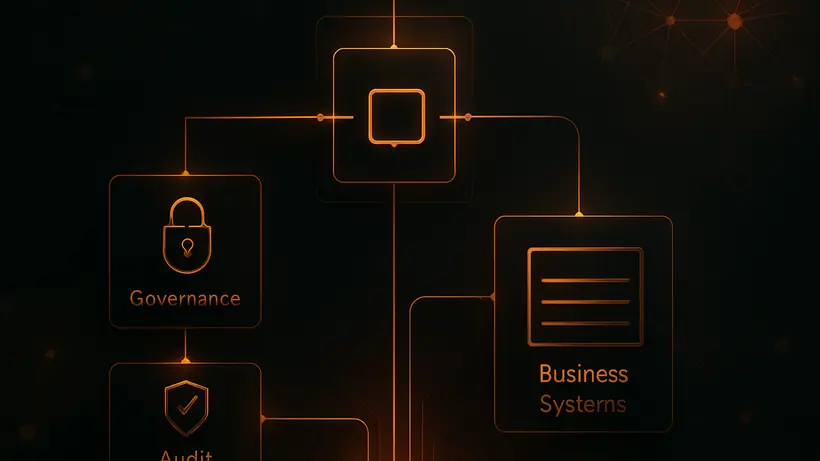
The surviving 60% aren’t using smarter models. They’re building smarter systems.
4. Canceled vs. Surviving: The Short Version
| Canceled projects | Surviving projects |
|---|---|
| Goal was ‘adopt AI’ | Goal was one measurable business metric |
| Agent bolted onto systems it can’t safely reach | Secure, audited access built first |
| No human oversight or audit trail | Approval gates and a full decision log |
| Automate a whole department at once | One workflow proven, then expanded |
| LLM guesses at answers | LLM reasons over what code computed |
| Blames the model, swaps providers | Fixes the system around the model |
5. Are You Set Up to Survive? Take the 90-Second Check
Before you green-light a project, you should be able to answer three questions: what single measurable outcome the agent owns in its first 90 days, how it reaches your production systems securely and who signs off on consequential actions, and what happens - visibly - when it hits the limit of what it can do reliably. If you can’t answer those, the model isn’t your risk; the system around it is.
Which cancellation risks are you carrying?
Tick each that’s true of your current or planned agent deployment.
- No single, measurable outcome the agent owns in its first 90 days
- The agent can’t yet reach the production systems it needs securely and auditably
- No human approval gates on consequential actions, and no full audit trail
- The plan is to automate a whole function at once, not prove one workflow first
- The design leans on the model to “know” answers rather than reason over verified data
These aren’t AI questions. They’re operating questions - the same ones you’d ask before handing any new hire authority over a live process. That discipline is exactly what an agentic AI operating system provides, and it’s why the businesses we build for land in the 60%. One of them cut operational costs by 68% doing exactly this.
If This Were Your Deployment, Here’s Our First Move
We’d ignore the model choice entirely at first. We’d pick one painful, measurable workflow, wire secure and audited access to the systems it touches, put a human approval gate on anything irreversible, and prove the number in 90 days. Then - and only then - extend the same pattern to the next workflow. Unglamorous, and exactly why it works.
If you want to deploy agents that survive contact with production, let’s map it out together.