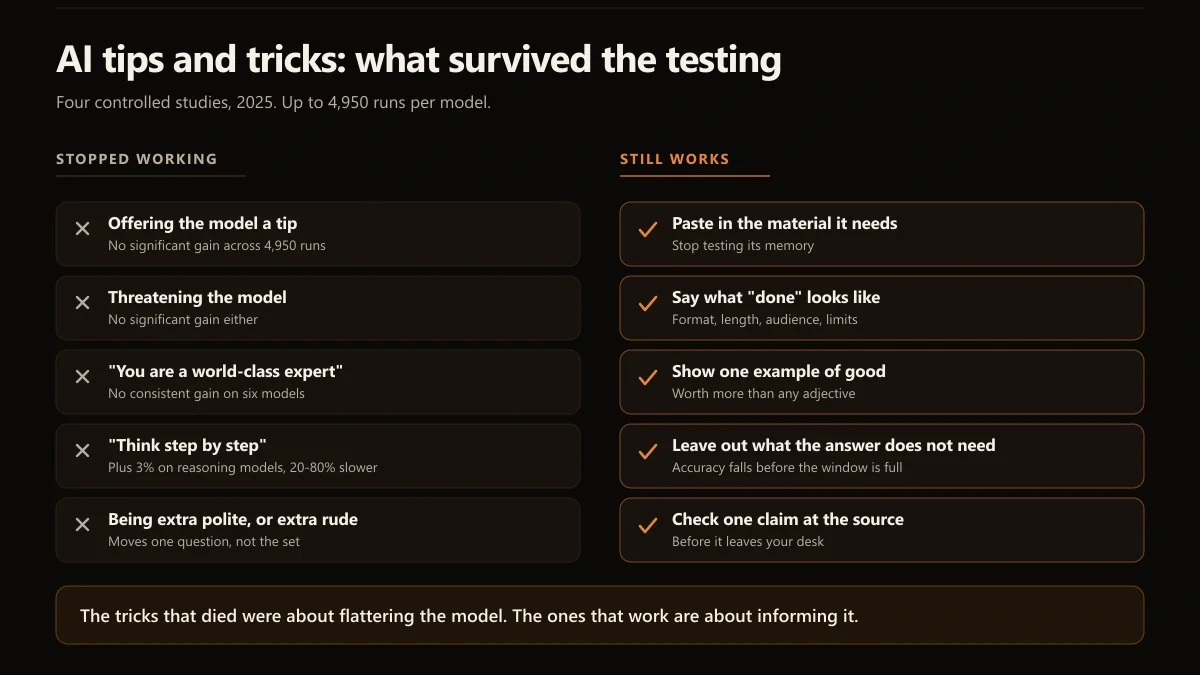
In short: The AI tips and tricks that survive controlled testing all either supply information or define what a finished answer looks like, while tipping, threatening and expert personas have been measured on public benchmarks and do nothing.
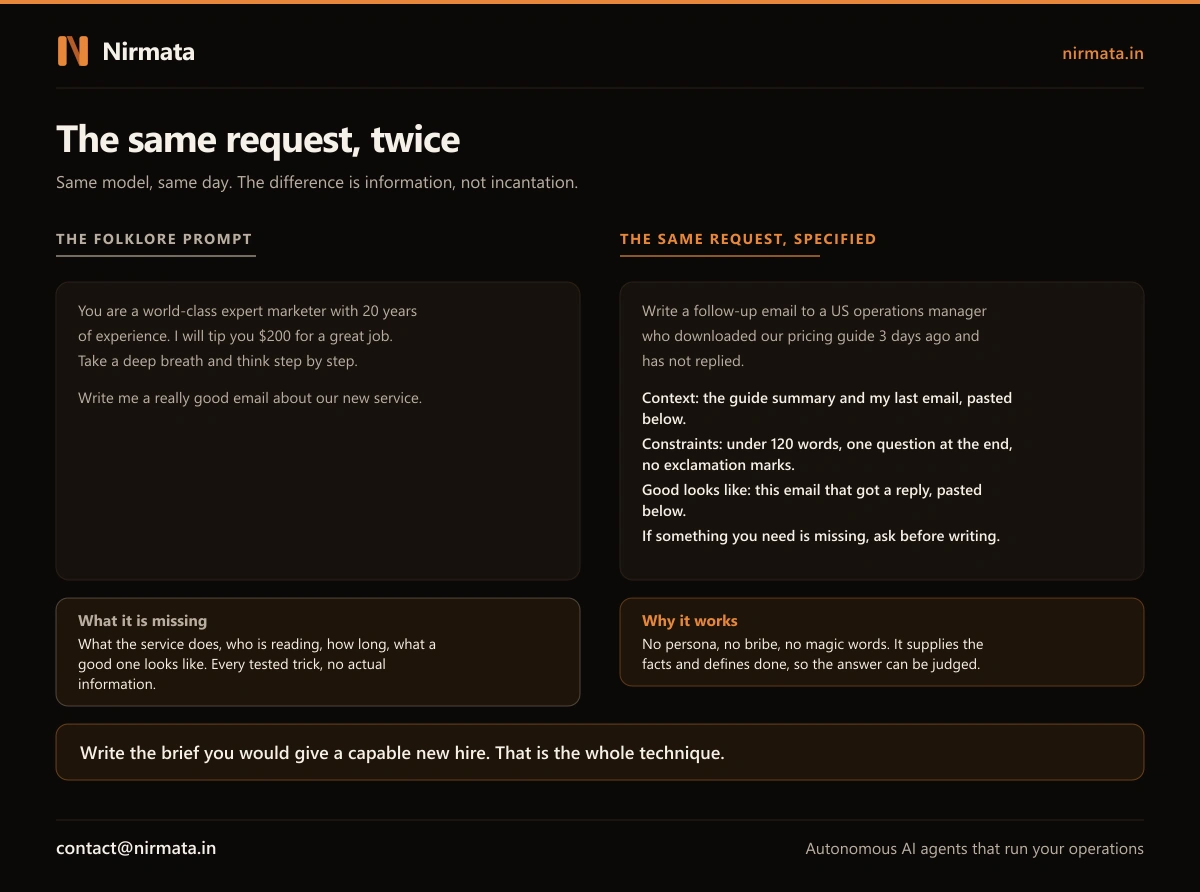
Somewhere in your team’s saved notes there is a prompt that starts like this: “You are a world-class expert with 20 years of experience. Take a deep breath and think step by step. I will tip you $200 for a great answer.”
None of that does anything. Four separate controlled studies have now tested those exact instructions on public benchmarks, with 25 trials per question, and published the results. Almost every list of AI tips and tricks still circulating was written in 2023 and never revisited when the models changed underneath it.
The gap matters more than it used to. Pew Research now puts chatbot use at 49 percent of US adults, with 38 percent of employed adults using one for tasks at work, from a survey of 5,119 adults fielded in February 2026. A great many people are following advice that has been measured and found to do nothing.
What survives testing has one thing in common. It supplies information, or it defines what a finished answer looks like. What died was all about flattering, bribing or coaxing the model.
What AI tips and tricks actually work in 2026?
Give the model the source material instead of relying on its memory. State the output format, the length and the audience. Show one example of an answer you were happy with. Include only the context the answer depends on. Then check one specific claim before you use it. Personas, tips, threats and “think step by step” have all been tested and do not reliably help.
1. The tricks that quietly stopped working
Wharton’s Generative AI Labs has published four Prompting Science reports for the specific purpose of testing popular prompting advice rather than repeating it. The pattern across them is consistent.
What the tests found
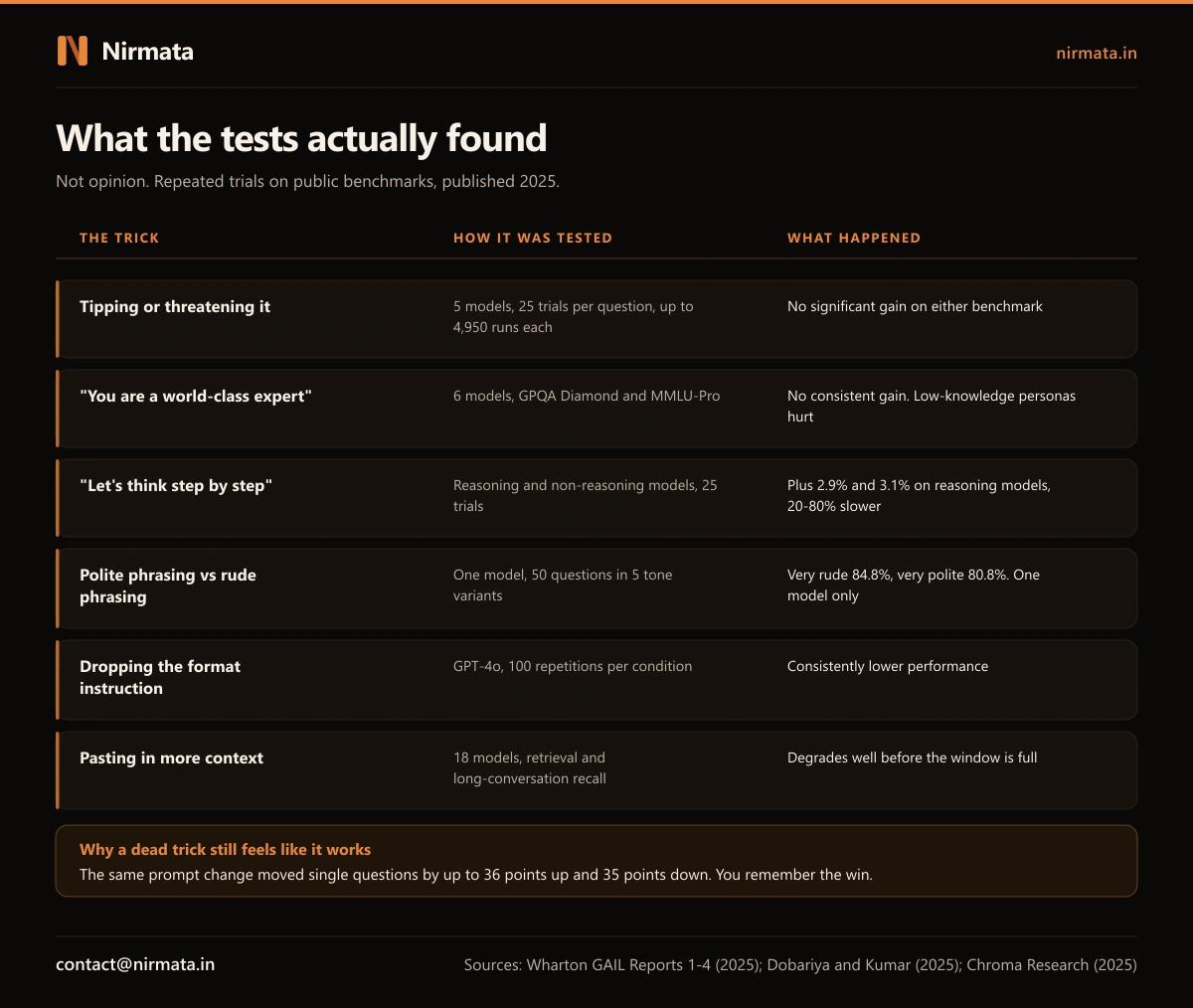
- Tipping and threatening the model: no effect. Prompted by a widely shared claim that models perform better if you threaten them, researchers ran five models across two benchmarks at 25 trials per question, up to 4,950 runs per model. Neither tips nor threats significantly improved results.
- Expert personas: no consistent gain. Six models, 25 trials per question, graduate-level questions across science, engineering and law. Telling the model it was a physics expert before asking it physics produced no significant improvement, with a single model the only exception. Personas describing low knowledge consistently made accuracy worse, and mismatched expert personas pushed one model into refusing the question about 10 times in every 25 attempts.
- “Think step by step”: largely redundant now. On reasoning models the average gain was 2.9 and 3.1 percent while responses took 20 to 80 percent longer, and one model got 3.3 percent worse. On older non-reasoning models the same instruction still helped, by as much as 13.5 percent. The advice did not stop being true, it moved, because reasoning models now do this without being asked.
- Politeness and rudeness: neither is a technique. A Penn State study of 250 prompts on one model found rude phrasing scoring slightly higher than polite, 84.8 percent against 80.8 percent. Wharton separately found that “please” versus “I order” could move a single question by up to 60 percentage points while washing out across the full set. Read together, tone is noise.
One result cuts the other way, and it is the one nobody repeats: removing the instruction that specified the output format lowered performance consistently. Telling the model how to answer works. Telling it who to pretend to be does not.
“But it worked when I tried it”
It probably did, once. In the tipping and threatening study the same prompt change moved individual questions by as much as 36 percentage points in the right direction and 35 in the wrong one. Try a trick twice and you will see something happen. That is variance, and it is exactly why prompting folklore spreads: everyone has a success story and nobody keeps a control group.
2. Give it the material instead of testing its memory
The highest-return change most people can make is to stop asking questions from memory and start pasting in the thing the answer depends on. The contract. The error log. The last three emails in the thread. The actual policy.
Ask a model about your refund policy and it will produce a refund policy. Fluent, plausible, correctly shaped. Whether it matches yours is a coin toss, and the failure is invisible because nothing about the output looks wrong. That is the mechanism behind most of what gets called hallucination, which we took apart in why AI hallucinates, forgets and argues.
The same principle scales. When a company’s AI keeps getting that company’s own business wrong, the cause is rarely the prompt. Nobody gave the system access to a reliable version of the facts, which is the problem underneath AI that gets your own business wrong.
3. Say what done looks like before you ask
The persona study closes with a recommendation worth quoting precisely because it is the opposite of a trick: organizations may get more value from iterating on task-specific instructions, examples and evaluation workflows than from adding expert personas to prompts.
In practice that is four unglamorous moves. State the format and the length. Name who reads it. Paste one example of an answer you were happy with. And say what to do when something is missing, instead of hoping it will ask. That last one prevents the most common failure of all, which is a confident answer built quietly on a guess.
4. Less context beats more context
Long context windows created a habit of pasting in everything available, on the theory that more cannot hurt. It can. Chroma tested 18 models and found performance degrading as input grew, well before any window was close to full. A single irrelevant passage measurably reduced accuracy, and four compounded it.
The strangest finding is the most useful one. Models did worse when the surrounding text held a logical flow of ideas than when the same text was shuffled, and that held across all 18 models. Coherent, related, almost-relevant material is the most expensive noise you can add, and it is exactly the kind people paste in.
What to do instead
- Paste the two paragraphs the answer depends on, not the whole document
- Start a new conversation when the subject changes rather than extending a long one
- Treat a thread that has started going in circles as contaminated, not as context
- Read a large context window as a capacity, not as a promise of accuracy across it
5. The habit that beats every trick combined
Pick one checkable thing in every output and check it. A number, a name, a date, a clause, a citation. Not the whole answer. One thing.
This works because errors are not spread evenly. They cluster in the specifics: the figure that was inferred, the quote that was reconstructed, the reference that sounds exactly like a real one. Fluent prose wrapped around a wrong number is the failure mode, and one deliberate check per output catches most of it for about twenty seconds of effort.
A number from one of our deployments
On one agentic deployment the error rate sat at roughly 4 percent while supervised and fell below 1.5 percent by day 60. Nothing about the prompts got cleverer in that time. What changed is that “correct” had been defined and was being checked on every run, which is the same move at system scale as checking one claim at your desk.
- The facts the answer depends on are pasted in, not left to memory
- The output format, the length and the audience are stated
- One example of a good answer is included wherever format matters
- Everything the answer does not need has been left out
- You have said what to do when information is missing
- One checkable claim is verified before the output gets used
Myth vs Facts
Myth: “There is a magic phrase that unlocks better answers.”
Fact: Five models, two benchmarks, up to 4,950 runs each, and the popular phrases produced no significant gain. What did show up was individual questions swinging by up to 36 points in both directions from the same change. That is variance, not a technique.
Myth: “Telling it that it is an expert makes it smarter.”
Fact: Across six models, expert personas produced no consistent improvement on graduate-level questions, and personas describing low knowledge reliably made things worse. A persona still shapes voice and register, because an executive summary should not read like a developer note. It does not buy accuracy.
Myth: “Adding think step by step always helps.”
Fact: It helped older non-reasoning models by as much as 13.5 percent. On reasoning models it bought roughly 3 percent for 20 to 80 percent more waiting, and one model got worse. The instruction is not dead, it is model-specific, and most people are now adding it to models that already do it.
Myth: “A huge context window means I can paste everything in.”
Fact: Accuracy declines as input grows regardless of how big the window is. One irrelevant passage is enough to measure, four compound it, and coherent surrounding text degraded results more than shuffled text across all 18 models tested. Capacity is not comprehension.
AI tips and tricks: the habit, the evidence, the replacement
| The habit | What the evidence says | What to do instead |
|---|---|---|
| Tipping or threatening the model | No significant gain, up to 4,950 runs per model | Ask plainly and specify the output |
| “You are a world-class expert” | No consistent gain across six models | Use a persona for tone, never for accuracy |
| Adding “think step by step” | About 3 percent on reasoning models, 20 to 80 percent slower | Keep it for older non-reasoning models |
| Being extra polite, or deliberately rude | Moves single questions, washes out overall | Be clear and specific instead of either |
| Leaving out the format instruction | Consistently lower performance | State format, length and audience every time |
| Pasting in everything available | Accuracy falls well before the window is full | Paste only what the answer depends on |
What this means if you’re running AI in your business
Everything above is a desk habit, and desk habits have a ceiling. They rely on a person remembering, and they stop at the edge of one conversation.
Notice why the surviving tips are the boring ones. Each is a thing a system can hold and a person cannot: facts pulled from the source of record on every run, an output format fixed in the definition rather than retyped into the request, a verification step that happens whether or not anyone is watching. Prompting is how you find out what the work actually needs. A deployment is where that stops depending on who is at the keyboard. The habits worth standardizing across a whole team are in our 27 AI rules for business owners.
Which prompting superstition are you still paying for?
Tick each that applies to you.
- You have a saved prompt that opens by telling the model it is an expert
- You add “think step by step” to a model that already reasons
- You paste in whole documents when two paragraphs would do
- Nobody on your team has written down what a good output looks like
- You have never checked an AI number against the source it came from
If This Were Your Deployment, Here’s Our First Move
We would ignore the prompts at first and ask a different question: which three requests does your team send to a model every single week? Those are not prompts. They are undocumented processes, and they are where the same effort gets spent again every time.
Then we would do to each one what the evidence says works. Wire it to the real source of the facts so nobody is pasting. Fix the output format in the system rather than in the request. Add the rule that makes it ask instead of invent. Put one check on the specifics that runs every time. At that point it has stopped being a tip and become something that behaves the same on a Monday as it does on a Friday.
If your team is trading prompt tricks and still not trusting the output, tell us what you keep asking it to do and we will show you which of those three is worth turning into a system first.