In short: FIFA’s AI worked because it was aimed at a single objectively decidable question on a fully instrumented pitch, with a human referee still making the call, and it drew criticism precisely where those conditions stopped holding.
A goal goes in. The crowd erupts. Then the pause everyone now recognizes, a 3D replay on the big screen, and a decision that either stands or evaporates.
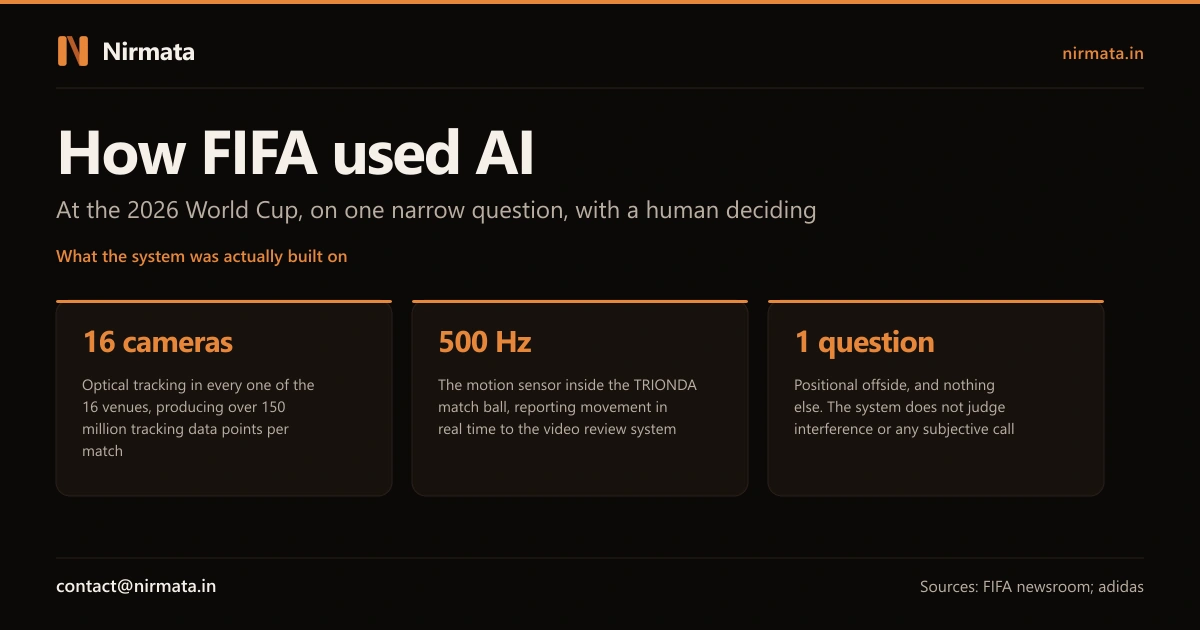
Behind that pause at the 2026 World Cup sat one of the largest live AI deployments ever attempted: sixteen tracking cameras in every stadium, a sensor inside the ball reporting five hundred times a second, and a 3D scan of every player at the tournament. It ran in front of billions of people with no opportunity to quietly roll back a bad release.
What is worth studying about how FIFA used AI is not the scale. It is how narrow FIFA kept the system, and where the criticism landed anyway.
How did FIFA use AI at the 2026 World Cup?
FIFA used AI mainly to speed up offside decisions. Optical tracking cameras follow player limb positions, a motion sensor in the match ball pinpoints the moment of contact, and the system flags likely positional offsides for the video review team. It also gave every team a generative AI analysis assistant. Referees still decide.
1. The environment was instrumented before the AI was asked to do anything
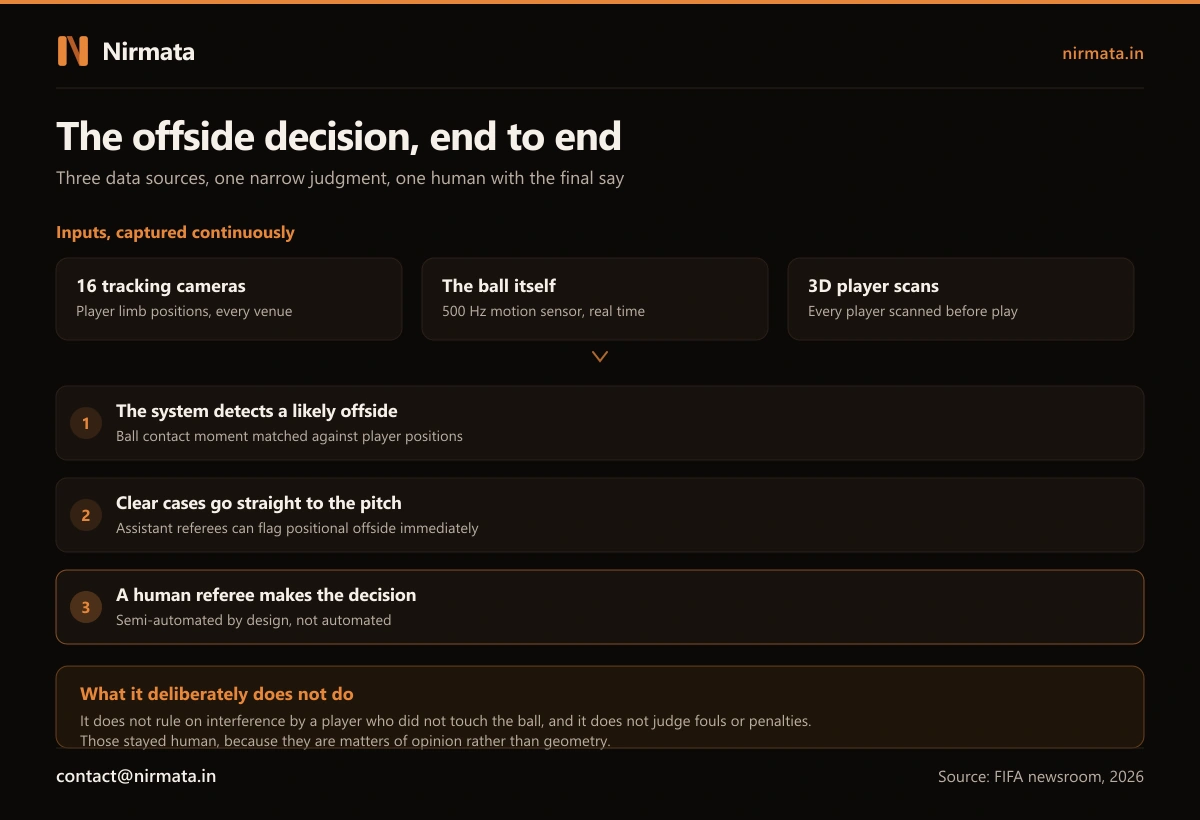
The part nobody puts in a press release is the measurement layer. According to FIFA’s own account of the tournament technology, there were sixteen optical tracking cameras in each of the sixteen venues, generating over 150 million tracking data points per match. Every participating player was 3D scanned so their digital avatar could be used by the system and in broadcast replays.
The ball was part of the instrumentation too. The TRIONDA match ball carried a 500Hz motion sensor built into a panel layer, feeding ball data to the video review system in real time so it could be combined with player positions.
Note the order of operations. The data existed, at known precision, before anyone asked an algorithm for a verdict. Most business AI projects invert this and then wonder why the answers are unreliable, which is the same failure we described in why AI gets your own business wrong.
2. It was pointed at one question with a right answer
This is the discipline most companies skip. The system judges positional offside, which is geometry: where a player was at the moment the ball was played. It does not decide whether a player who never touched the ball interfered with play, and it does not rule on fouls or penalties.
Why that boundary matters
- Offside position has a verifiable answer, so the machine can be measurably right or wrong
- Interference is a judgment about intent and effect, so there is no ground truth to check against
- Fouls are contested by definition, which is why no amount of tracking data settles them
- Keeping the scope narrow made the system auditable, which is what made it trustworthy enough to deploy
Automating the objectively decidable and leaving the arguable to people is not a compromise. It is the design.
3. A human still makes the call
The name is the giveaway: semi-automated offside technology. FIFA describes clear offsides being sent directly to the officials on the pitch so assistant referees can flag positional offsides immediately, but the decision remains a human one. The AI compresses the time to an answer; it does not own the outcome.
That is an approval gate, exactly the pattern we build into agent deployments where being wrong is expensive. The reason it works here is that the gate sits at the point of consequence, not somewhere upstream as a formality.
4. The most business-relevant thing FIFA did was not the offside system
Buried in the same announcement is something closer to what most companies actually need. FIFA gave all 48 teams a generative AI analysis assistant, Football AI Pro, which replaced match reports that previously ran to 50 or 60 pages, and gave every team the same access to pre-match and post-match analytics.
Two things happened there. A document nobody could read fast enough during a tournament became a system you could ask a question of. And access was levelled deliberately, so analytical capability stopped being a function of which federation had the biggest backroom staff.
That is the shape of the highest-return AI work inside ordinary businesses: not a moonshot, but the weekly report that arrives too late and too long, turned into something a manager can interrogate in the moment.
5. It failed publicly once, and that is the most useful part
During the group stage, the semi-automated offside system was unavailable for a contested goal in Qatar against Switzerland. FIFA attributed it to a technical outage, the usual 3D confirmation graphic did not appear, replays were inconclusive, and the decision drew heavy criticism.
Nothing about that is unusual for a production system. What is instructive is that the tournament continued, because the fallback was the process that existed before the technology: officials making a call from what they could see. The failure was embarrassing, not fatal, because a human path still existed.
Ask yourself the equivalent question about your own automation. If it stops working at 9am on a Monday, does the work stop, or does it degrade to something slower that still functions? Most businesses have never tested this, and discover the answer during the outage.
Myth vs Facts
Myth: “AI now referees football matches.”
Fact: It measures one thing and alerts humans. FIFA’s system determines positional offside and explicitly does not judge interference by a player who did not touch the ball, nor fouls, nor penalties. Every decision that reached a scoreboard passed through a person.
Myth: “The technology ended the arguments.”
Fact: It moved them. Because the system resolves margins invisible to the eye, disputes shifted from whether a call was correct to whether a decision by a matter of millimetres should overturn a goal. Precision on the objective part made the remaining subjective part more conspicuous, not less.
Myth: “This only works with a billion dollar budget.”
Fact: The cameras and the sensor ball are expensive; the decisions that made them work are free. Instrument before you automate, choose a question with a right answer, keep a human at the point of consequence, and plan for the day the system is down. None of that requires a stadium.
Myth: “If the AI is good enough, you can remove the human.”
Fact: FIFA deployed one of the best-funded computer vision systems in existence and still designed it as semi-automated. The human is not there because the model is weak. The human is there because someone has to be accountable for a decision that cannot be reversed.
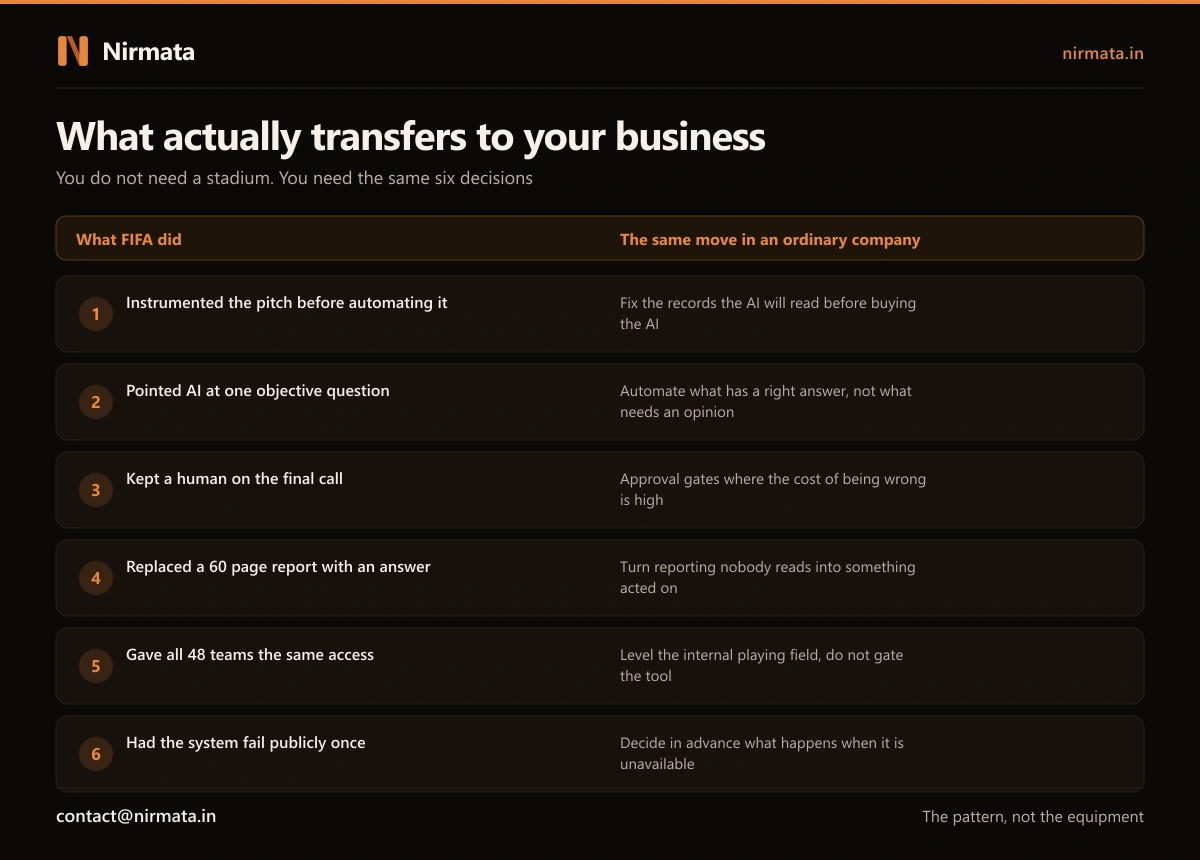
How FIFA used AI, mapped to your business
| What FIFA did | Why it worked | Your version of it |
|---|---|---|
| Instrumented every venue first | The data existed at known precision | Fix the records before buying the tool |
| Automated positional offside only | The question has a verifiable answer | Start where right and wrong are checkable |
| Left interference and fouls to humans | No ground truth to automate against | Do not automate matters of opinion |
| Kept the referee deciding | Accountability stayed with a person | An approval gate at the point of consequence |
| Replaced a 60 page report | Answers beat documents under time pressure | Target the report nobody finishes reading |
| Survived an outage | The manual path still existed | Test what happens when it is unavailable |
What this means if you’re running AI in your business
The temptation with a story like this is to conclude that AI is now good enough to take decisions off your hands. FIFA’s own design says the opposite. With effectively unlimited budget, world-class vision systems and a fully instrumented environment, the sensible configuration was still narrow scope plus a human at the end.
The transferable lesson is a sequence, and it is the same one we apply on engagements: measure the thing properly, pick the decision with a right answer, put the person where the consequence lands, and know your fallback. Skip any of the four and you get a system that produces confident output nobody can defend, which is what AI mistakes actually cost businesses. The broader habits behind this sit in our 27 AI rules for business owners.
- The data your AI will read is already measured, and you know how accurate it is
- The first decision you automate has a verifiable right answer
- Anything requiring judgment is routed to a person, by design rather than by accident
- The human gate sits where the consequence lands, not upstream as a formality
- You have tested what the process does when the system is unavailable
- The output is something a person can act on, not a document they will skim
Would your automation survive a World Cup?
Tick each that applies to you.
- You cannot state how accurate the underlying data is
- The first thing you automated involves judgment rather than a right answer
- Nobody is clearly accountable for a wrong automated decision
- There is no manual fallback if the system goes down for a day
- Your AI produces reports rather than answers to questions
If This Were Your Deployment, Here’s Our First Move
We would find your version of positional offside: the highest-volume decision in your business that has an objectively right answer and is currently made slowly by a person reading something. That is where automation pays first, and where it can be proven right or wrong.
Then we would instrument it before automating it, put the approval gate where the money or the risk sits, and write down what happens when the system is unavailable. That sequence is the whole method, and it is why our deployments tend to be narrower than clients expect and more durable than they expect.
If you want help finding that first decision in your own operation, tell us how your work moves today and we will point at the one worth automating first.