In short: The September 29 executive order requires federal agencies, not private companies, to say Super Intelligence instead of AI, so most businesses should change nothing, while federal sellers should mirror the new term and watch the federal definition due November 28.
If you searched for it this week, an AI summary probably told you yes, the term AI is being replaced. That is half right, and the half it gets wrong is the half that matters to a business.
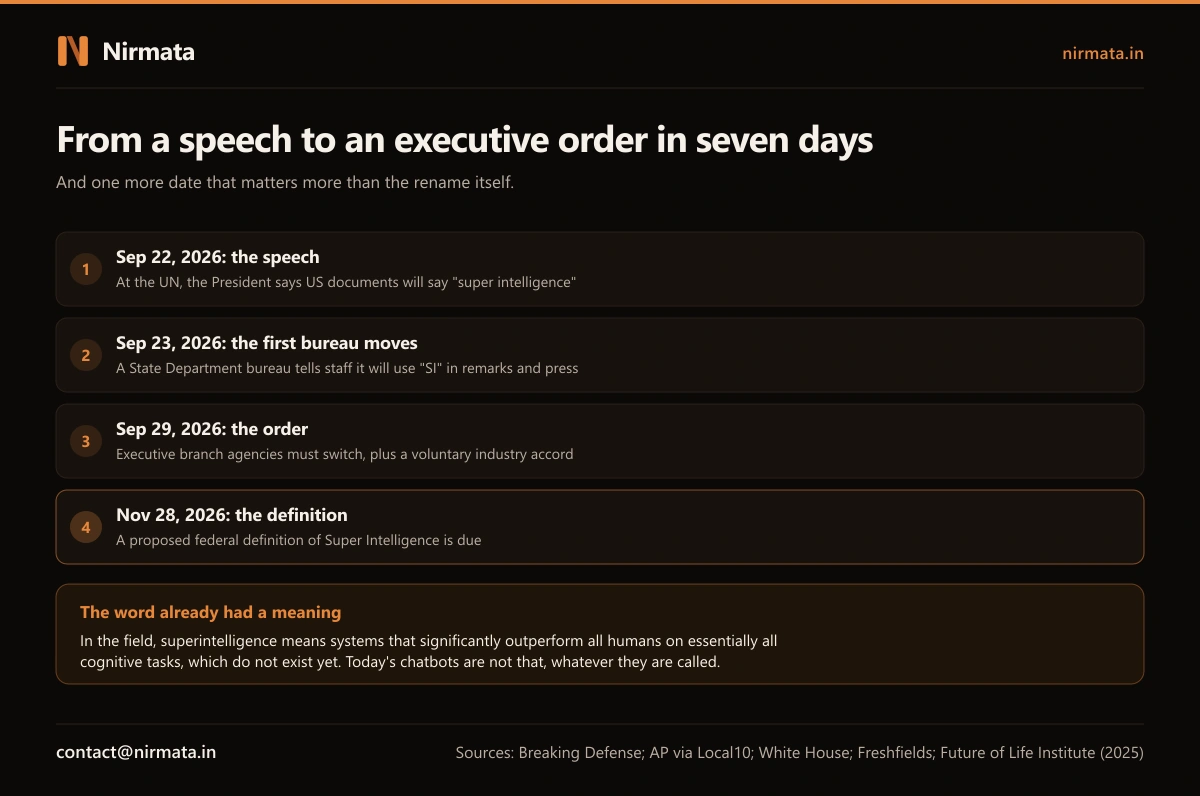
On September 29, 2026, the President signed an executive order directing federal agencies to stop using “artificial intelligence” and use Super Intelligence, or SI, instead. It followed a speech at the United Nations a week earlier, in which he said the word artificial makes the technology sound fake.
So should your website, your pitch deck and your product pages switch to super intelligence? For almost every private company the answer is no, and doing it would cost you. But the order does change something real for anyone who sells to the federal government, and one date inside it matters more than the rename itself.
What does the super intelligence executive order actually change?
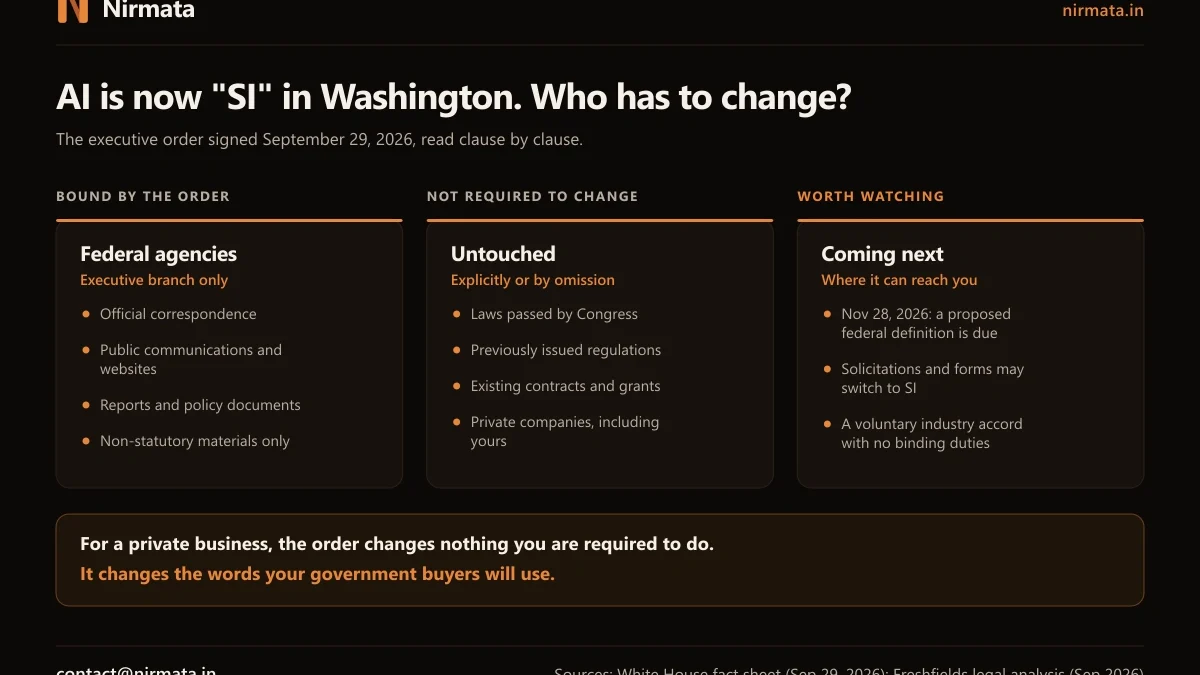
It requires executive branch departments and agencies to use “Super Intelligence” and “SI” in official correspondence, public communications, websites, reports and other non-statutory documents. It does not change laws passed by Congress, does not require agencies to revise existing regulations, contracts or grants, and places no obligation on private companies.
1. Who is bound, and who is not
The White House fact sheet is direct about the agencies: they are to use the new terms and no longer acknowledge “Artificial Intelligence” or “AI” in the materials covered. The limits matter as much as the instruction. Freshfields’ analysis of the order notes it does not require agencies to revise previously issued regulations, presidential actions, contracts, grants or other historical documents, and statutes are excluded outright.
Some of government moved before the ink. The day after the speech, a State Department bureau told its staff it would be using SI in all remarks, positions and press elements, and US representatives used the term at a UN Security Council meeting on the technology.
For the private sector, the order itself is silent. Alongside it, the White House convened technology companies to sign a parallel accord on internal controls, monitoring, independent assessment and board oversight. It is voluntary, and the reporting is clear that it creates no enforceable obligations.
2. The word already meant something else
This is the part that will cause the most confusion in practice. In the field, superintelligence is not a synonym for AI. It names a destination. A widely cited 2025 statement from the Future of Life Institute defines it as AI that can significantly outperform all humans on essentially all cognitive tasks, and no such system exists yet.
The industry uses the word the same way. OpenAI has described turning its aim toward superintelligence in the true sense. Meta renamed its AI division Meta Superintelligence Labs in 2025. An entire company, Safe Superintelligence, was founded in 2024 to build it. So from this week, the federal government calls a spreadsheet assistant SI while the companies building frontier systems use the same word for something none of them has made.
Do not borrow the word for your marketing
It is tempting to ride the news and describe your product as super intelligence. Do not. In the field that word is a claim about capability, and a claim your product cannot support. The FTC’s Operation AI Comply established that there is no AI exemption from the laws against deceptive claims, and a government renaming its own documents does not change what a buyer is entitled to infer from yours.
3. Why your website should keep saying AI
Your buyers did not change their vocabulary on September 29. They still search for AI agents, AI automation and AI consultants, and every page you have that ranks for those phrases earned that position over months. Renaming them trades proven search demand for a term almost nobody outside government types, and changing URLs breaks every link pointing at them.
Notice what the government itself chose not to do. It left its laws, its regulations and its signed contracts alone, because renaming documents already in force is expensive and creates ambiguity about what they mean. If the federal government will not rename its own contracts, your sales pages do not need to be renamed either. Search visibility is under enough pressure already, as we covered in how exposed your website is to AI search.
And note how the story reached most people: through AI summaries that compressed “agencies must” into “the term is being replaced.” Confident compression of a nuanced fact is a familiar failure, the same pattern behind why AI hallucinates and argues. Read the primary source before you act on a summary.
4. If you sell to the federal government, act on the vocabulary
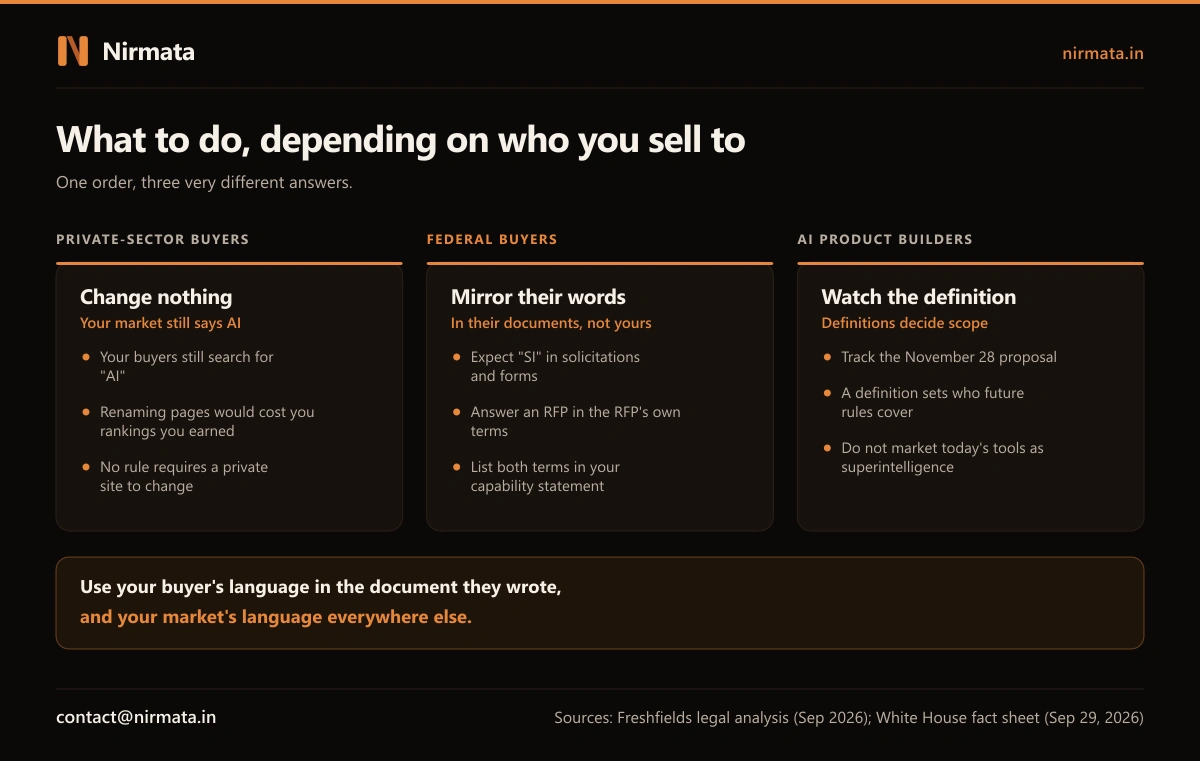
This is where the order touches the private sector, indirectly but for real. Freshfields’ guidance is that federal contractors, grant applicants and companies filing regulatory comments should expect agency solicitations, forms and official correspondence to adopt the new nomenclature going forward.
What that means in practice
- Answer a solicitation in the solicitation’s own terms. If the agency writes SI, your response should too
- Add a one-line glossary to proposal templates mapping Super Intelligence (SI) to artificial intelligence (AI)
- Put both terms in your capability statement so evaluators searching either one find you
- Update saved procurement searches. An alert for “AI” will quietly miss a notice that only says SI
None of this requires changing your brand. It is the same discipline as using a customer’s own words in a proposal: their document, their vocabulary.
5. The date that matters more than the name
Buried in the order is the provision with real consequences. The Assistant to the President for Science and Technology has 60 days, to November 28, 2026, to propose a federal definition of Super Intelligence, including whether it should modify, expand or supersede the existing statutory definition of AI and which laws would need conforming amendments.
Definitions decide scope. According to Freshfields, a statutory definition could shape future federal incentives, export controls, oversight, compliance obligations and government contract requirements. A definition drawn narrowly around frontier systems would leave most businesses outside it. One drawn broadly around any machine learning system would pull far more products into whatever rules follow.
“It is just a word”
In a press release, yes. In a statute, a word is a boundary. Every obligation that attaches to “Super Intelligence” will apply to whatever the definition says that is, so the name is the least interesting part of this order and the definition is the part worth a calendar reminder.
- You know whether any of your revenue comes from federal agencies
- Saved procurement searches include SI and Super Intelligence as well as AI
- Your capability statement uses both terms
- Proposal templates carry a one-line glossary mapping SI to AI
- Your marketing makes no superintelligence claims about today’s products
- Someone owns reading the definition proposed on November 28, 2026
Myth vs Facts
Myth: “AI has officially been renamed super intelligence.”
Fact: Only in executive branch agency materials. Laws passed by Congress still say artificial intelligence, existing regulations and contracts were not required to change, and the industry, standards bodies and other governments still say AI.
Myth: “Private companies now have to use SI.”
Fact: The order places no obligation on private companies. The accompanying industry accord is voluntary and, according to the legal analysis, creates no enforceable obligations or enforcement mechanism.
Myth: “The new name means the technology got smarter.”
Fact: Nothing about the technology changed on September 29. In the field, superintelligence describes systems that outperform all humans on essentially all cognitive tasks, and none exists. The tools you used last week are the same tools.
Myth: “It is only a name, so none of this affects us.”
Fact: If you sell to agencies, their documents will use the new term and your keyword alerts may miss them. And the definition due November 28 could set the scope of future compliance and contract requirements, which is not cosmetic at all.
Super intelligence rename: what changes for you
| If you are | What changes | What to do |
|---|---|---|
| A private-sector B2B seller | Nothing you are required to do | Keep AI on your site and in your pitch |
| A federal contractor | Solicitations and forms may say SI | Mirror the agency’s term in responses |
| A grant applicant | Applications may use the new term | Use both terms with a one-line glossary |
| An AI product builder | A federal definition is coming | Track the November 28 proposal |
| A marketer | A tempting news hook | Do not claim superintelligence for today’s tools |
| Monitoring procurement | Alerts for “AI” can miss SI notices | Add both new terms to saved searches |
What this means if you’re running AI in your business
Names change and plumbing does not. The agents, models and integrations that run your operations do exactly what they did before September 29, and so do the questions worth asking about them: what they can access, what they cost, how you know they are right.
We are keeping the word AI on our own site for the reasons above: it is what our clients search for, and it makes no claim we cannot back up. Where we write for a federal reader, we will use their term in their document. That split, buyer’s language in the buyer’s document and market language everywhere else, is the whole policy, and it sits alongside the habits in our 27 AI rules for business owners.
Is the SI rename your problem?
Tick each that applies to you.
- You sell to federal agencies, or plan to within the next year
- You apply for federal grants
- You find federal opportunities through saved keyword searches
- Your product could fall inside a broad federal definition of AI
- Someone on your team has suggested renaming your own pages
If This Were Your Business, Here’s Our First Move
We would spend ten minutes on one question: does any of your revenue come from federal agencies, now or in the pipeline? If not, the right action is to change nothing and get back to work, and we would tell you so.
If it does, we would add the new terms to your procurement alerts the same day, put a glossary line into your proposal templates, update your capability statement, and put November 28 in a calendar with a named owner. That is an afternoon of work that keeps you visible to evaluators without giving up anything your market already knows you for.
If you want a second opinion on whether this touches your pipeline, or on what the coming definition could mean for your product, tell us who you sell to and we will give you a straight answer.